
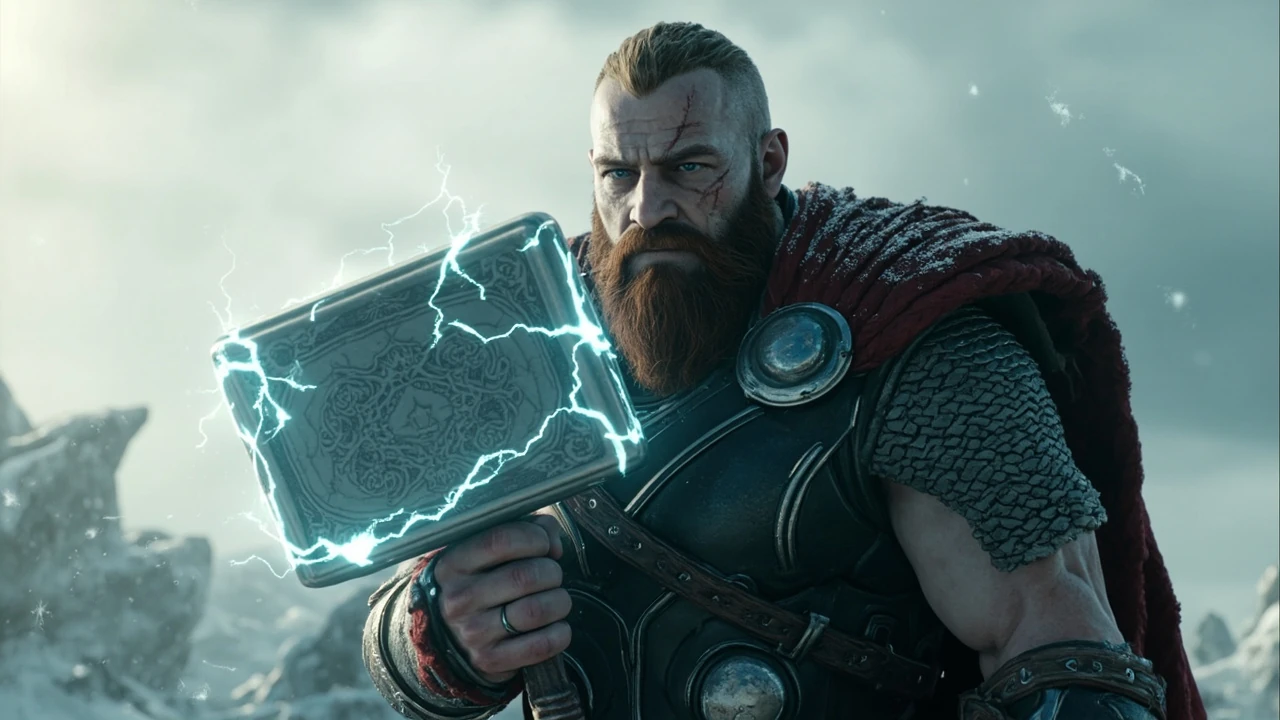
Thor in God of War Ragnarok is one of the most discussed character and boss encounters in recent PlayStation productions because the team at Santa Monica Studio rebuilt a mythic figure in a way that conflicted with the source material many players expected. The character is larger than Kratos, deeply unhygienic, verbally restrained, and written as a tragic figure rather than a hammer-swinging showpiece. The fight itself is built around that writing, with a phased encounter that asks the player to learn a long, multi-stage duel rather than brute force through a quick set piece. For a GameDev audience, the case is interesting because Thor is a clear example of how character design, narrative beats, animation, and encounter design are stitched together, and how a studio can defend a deliberate risk when the IP is decades old.
This article looks at the design and production decisions that shaped the God of War Ragnarok Thor encounter, from early character writing through animation, cinematography, combat scripting, and the boss fight itself. The goal is practical: developers, technical artists, designers, and producers can take something from the way the team resolved a tension between player expectation and creative direction, while players get a clear map of the encounter that explains why the fight is structured the way it is.
God of War Ragnarok Thor: the design problem the team had to solve
Thor in the previous Norse God of War games was a background character defined mostly by implication. Players heard his name, saw a vision in God of War (2018), and understood him as the hammer-wielding thunder god who would eventually arrive. When Ragnarok was scoped, the team had to decide what that arrival actually meant. The easy version of Thor is a screen-filling power fantasy that ends in a one-hit kill on Kratos. The interesting version is the one the team shipped.
From a production standpoint the question is not just “what does Thor look like” but “what does Thor do for the story and the systems.” If Thor is a god of raw power, his mechanical function in combat is clear: high health, high damage, punishing area attacks. If Thor is a fractured father, a depressed alcoholic, and an abused son, his mechanical function is more layered. The encounter needs to feel like fighting someone who could end the protagonist at any time and chooses not to, or who is only barely held together by a godlike body.
That tension shows up in three places that the rest of this article follows: the writing, the character and animation design, and the boss fight itself. Each of those is a separate discipline, but they were solved as one problem in pre-production. The headline, summarized in a 2016 report on the studio’s character direction, was that the team pointed to the Hulk as a reference for a god whose physical scale is in conflict with his emotional state.
Writing Thor as a broken god
Narrative direction for Thor came from creative director Cory Barlog and his team, with writing credits shared across the studio. In interviews around launch, the team described wanting to avoid a “thunder god as a power fantasy” reading and instead portray a man who has been used by his father Odin for a thousand years and has nothing left. The writing team leaned on a few specific decisions:
- Thor is introduced visually before he is introduced verbally. The first time players see him up close, he is unkempt, hungover, and uninterested in the visitors in his hall.
- Thor speaks slowly and quietly, especially in contrast to Kratos. The voice performance leans into low register and short sentences, so the threat is in what he does, not what he says.
- Thor’s relationship with Odin is shown rather than explained. A scripted mid-game scene turns the dynamic into a visible abuse loop that players experience firsthand, with Thor’s body language shifting when Odin enters the room.
- Thor’s role as a father is treated as the through-line of his character, not a sidebar. His final mechanical choice in the story is anchored in the question of what he can and cannot do for his son.
For developers, the writing choices matter because they constrain every other discipline. Animation had to be able to sell a body that is simultaneously massive and exhausted. Combat design had to be able to communicate restraint in a hammer-swinging boss. Cinematics had to be able to frame a quiet conversation in a hall built for a loud one. Each of those constraints is a brief, and each brief is the kind of thing a producer needs to track from pre-production through final cinematics.
Character and animation design for a tired god
The art direction for Thor is a useful case study in how a studio resolves the gap between player expectation and creative intent. Players entering Ragnarok have spent years with a version of Thor drawn from comics, films, and the marketing of earlier God of War games. The team made an early decision that this Thor would not look like that Thor, and they communicated that decision to the player through three specific visual choices.
Silhouette and proportion
Thor’s silhouette is wider than Kratos but not a clean muscle stack. The shoulders are heavy, the chest is soft, the jaw is wide, and the hair is long and unwashed. The mass is in the upper body, which gives the character a recognizable outline that still reads as broken rather than heroic. In animation, the team layered fatigue into the body language: the way Thor leans, the way he rests the hammer on his shoulder like a working man carrying a tool, the way he sits with one leg out and one knee up on the throne. None of these are “action” poses, which is the point. The character is performing authority, not power.
Costume and material language
The Thor costume is layered furs, worn leather, and a chest piece that is decorated but visibly uncared for. The furs read cold and rural, the kind of clothing a frontier warlord would wear, not a divine king. The team picked materials that animate with weight and that break the silhouette in ways a single breastplate would not. The hammer, Mjolnir, is similarly treated. It is dented, scratched, and large, but it is also dirty, and the team leaned into that. The prop team did not polish a god’s weapon into a logo, they made a working tool that a working god had been swinging for centuries.
Animation cues for the player
Thor’s animation sets have to do two jobs at once. They have to communicate threat, and they have to communicate restraint. The team built that contrast into a small number of readable beats. A wind-up before a swing is a long, slow draw of the arm, with weight on the back foot, that the player can read as a telegraph. The actual swing, by contrast, is fast and shockingly wide, and the follow-through is excessive. The result is a recognizable read cycle: slow, fast, slow, fast, with the recovery frames giving the player a window and the attack frames giving the encounter weight.
How the God of War Ragnarok Thor boss fight is structured
The Thor boss fight is a multi-stage encounter that begins in a narrative scene, not a combat scene, and ends in a choice that the player makes during a quick time event. That structure is a deliberate design statement. The team has said, in effect, that fighting Thor is not the point of fighting Thor. The point is what the player decides when Thor is no longer fighting. For developers, that means the fight has to be readable as both a combat challenge and a narrative argument. For players, it means the encounter rewards learning the fight itself more than learning a single trick.
Phase 1: the duel in the hall
The first combat phase takes place in a partly ruined Norse great hall, with Thor attacking as both a melee opponent and an AOE threat. The arena is wide but has cover positions and breakable columns. The phase mixes the following elements:
- Heavy melee swings with telegraphed wind-ups and long recovery frames, so the player can parry or roll.
- Mjolnir throws that the player can block with the shield if they have upgraded it, but that otherwise knock Kratos back and break combos.
- Area attacks with shockwaves that punish players who stand in the center of the hall.
- Brief cinematics where Thor stops the fight to insult Kratos or Odin, giving the player a moment to recover health or stamina if needed.
The hall itself is a teaching arena. The floor geometry is simple, the walls block line of sight to Mjolnir throws, and the columns are positioned to give a player a chance to learn the timing without forcing a playstyle. Designers often use first boss fights this way: a self-contained lesson in the combat system, written into a single room. The Thor fight in Ragnarok works the same way, but the lesson is layered into a character study.
Phase 2: the second duel
The second combat phase is a rematch on different ground, with a different version of Thor. The phase is faster, Mjolnir is used more aggressively, and Thor summons lightning in patterns that the player has to break line of sight from. The room is smaller, which raises the pressure on positioning. The player has access to more abilities at this point in the game, so the encounter is balanced around those abilities rather than reintroducing them.
Designers and producers reading this should note the trade-off. A second phase that is simply “harder phase one” wastes the player’s time and teaches them nothing. The Thor team used the second phase to change the rules. The first phase is a schoolroom, the second phase is an exam. That is a useful pattern for any long encounter, because it lets the encounter grow with the player rather than against the player.
Phase 3: the resolution
The final phase is a scripted sequence. The player makes a choice during a quick time event and the encounter ends. There is no health bar to drain in the conventional sense. The fight resolves because the player chose a response to a question that the fight has been building toward since the first cutscene.
That structure is a real production decision and not every studio should copy it. Some players will read a non-combat resolution as the game not letting them finish the fight. Other players will read it as the only honest ending for a fight with a character like Thor. The team accepted that tension and shipped the encounter as a hybrid combat and narrative scene. For a producer, the question is whether the marketing, the QA scripts, and the early access messaging prepare the audience for that hybrid. If they do not, the encounter is a review risk, even when the design is correct.
Encounter mechanics developers can study
The God of War Ragnarok Thor fight is a useful case study because the encounter’s mechanics map cleanly onto a small set of design lessons that show up in many third-person action games. The table below summarizes the design intent behind each mechanical element so that a developer can see how a single character’s writing, animation, and combat design pull in the same direction.
| Mechanical element | Player-facing behavior | Design intent | Production risk |
|---|---|---|---|
| Long, slow wind-ups before heavy attacks | Parry and roll are reliable, mistakes are punished | Make the player feel the weight of the character | Wind-up timing must remain readable on lower frame rates and in variable lighting |
| Mjolnir throw with area denial | Forces the player to break line of sight or use the shield | Introduces a ranged threat that respects the cover system | Shield tuning across difficulty modes must keep the throw survivable |
| Resting beats between attacks | Brief invulnerability and recovery windows for the player | Reward patience and let the player feel in control of the pace | Resting beats can collapse the difficulty curve on lower settings |
| Lightning AOE with visual telegraph | Player must read the ground effect and reposition | Teach the AOE read pattern that the game uses in other boss fights | Lightning VFX must remain visible without crushing the GPU budget on base hardware |
| Scripted mid-fight dialogue | Health and stamina recovery during narrative beats | Give the writing room to breathe inside the encounter | QA must validate that the recovery is never too generous or too stingy |
| Final scripted choice | Encounter ends with a player-driven QTE rather than a depletion bar | Tie the boss resolution to the character’s writing, not to a stat block | Marketing, previews, and difficulty descriptions have to be honest about the structure |
Each row in that table is a small brief. The point of writing the encounter down this way is that a producer or lead designer can audit the encounter against the brief and the writing at the same time, rather than treating combat tuning and narrative beats as separate conversations.
Animation, cinematography, and the look of restraint
Thor’s cinematic moments are a separate production track from the boss fight, even though they share the same character and stage. The cinematics team had to deliver scenes that look like they belong in the same hall as the combat, without ever showing Thor do anything in a cinematic that he would not do in combat. That is a useful constraint and a hard one. It is the reason a cinematic and a boss fight in the same room can still feel inconsistent if the animation, lighting, and camera language drift between teams.
Animation layering for a heavy character
Thor’s animation team built the character around three layers: a base layer of large, low-frequency motion; a secondary layer of small, fatigue-driven behavior like sighing or shifting weight; and a tertiary layer of facial performance for the cutscenes. Each layer is authored separately and blended at runtime, which lets the same animation data do the work of a melee swing, an idle breath, and a quiet conversation without re-authoring the entire character for each scene.
For technical artists, that is the interesting part. The team did not build one animation set for cutscenes and another for gameplay. They built a layered rig whose idle, walk, attack, and reaction animations were all authored in the same editor, with the cinematics team doing additional blend trees for camera-driven shots. That pipeline choice is what allows Thor to sit in a chair the same way in a wide cinematic and in a tight gameplay camera, and to swing the hammer the same way in a QTE and in a free combat moment.
Camera language for restraint
The camera team used distance as a storytelling tool. When For additional context, Thor is being abusive or quiet, the camera holds back and frames him in a wide shot that includes the room and the other characters. When Thor is furious, the camera pushes in and the frame tightens to a close two-shot with Kratos. The slow wind-up before a heavy attack is a third camera state, where the camera is locked at a near-shoulder position to make the telegraph readable. Each of those camera states is a discrete authoring decision that ties the writing, animation, and combat to a single read.
Performance, validation, and platform constraints
Thor’s character is one of the most expensive in the game by asset count and by animation data. A production team that has to ship that character on a base PlayStation 4, a mid-tier PlayStation 4 Pro, a base PlayStation 5, and a mid-tier PlayStation 5 digital edition has to make a small number of decisions early and stick to them. The team’s approach to performance for the Thor encounter can be summarized in three categories.
LOD and mesh sharing
Thor’s costume is built from a small set of meshes that are shared with the Mjolnir prop, the chair in the great hall, and the hall’s wall carvings. The mesh sharing is a deliberate production choice, not just a memory optimization. The visual language of the game is built on a small set of stone, fur, leather, and metal mesh families, and the team made sure Thor uses the same families as the world. The result is a character that reads as part of the environment, which is what the writing asks for. The same approach makes it easier to author a single LOD chain that holds up across platforms.
Animation LOD
The animation LOD for Thor is built around the same three layers as the character itself. At distance, the secondary and tertiary layers are dropped and only the base layer is evaluated. That is what allows a large number of Thor variants to be in the hall during a crowd scene without dropping frame time. For developers, the lesson is that an LOD strategy for a character like Thor is a content-authoring decision, not just a runtime optimization. The team has to know which animations are authored with which layer, and the editor has to support that distinction.
Lighting and exposure
The Thor scenes are lit warm and cold at the same time. The hall is lit with cool daylight from the doorway and warm torchlight from the side walls. The team used that split to give the character two readable sides: the warm side, which is the side that faces the player’s party, and the cold side, which is the side that faces the throne. The split also helps performance, because the warm and cold light sources can be authored as a small set of low-cost lights that drive most of the visible variation in the scene. For a developer targeting a base console, that kind of authoring decision is the difference between a scene that holds 30 fps and a scene that does not.
Where the encounter fits in the wider Ragnarok production
The God of War Ragnarok Thor boss fight is a useful spoke in the wider Ragnarok production because it sits between the game-world design and the cinematic design and forces both teams to agree on a single read of a character. The table below maps the encounter to the wider production responsibilities, so a producer reading this can see which teams had to commit to a shared brief.
| Production team | Primary deliverable for the Thor encounter | Shared brief constraint |
|---|---|---|
| Narrative | Character writing, voice direction, mid-fight dialogue beats | Thor’s lines must be consistent with a tired, restrained voice performance in both combat and cutscene |
| Character art | Thor mesh, fur, leather, Mjolnir prop, LOD chain | Costume must read in a wide cinematic and a tight gameplay camera without re-texturing |
| Animation | Base, secondary, and tertiary animation layers, blend trees, QTE data | Combat and cinematic animations must come from the same authored data, with no parallel rigs |
| Combat design | Phase structure, attack patterns, recovery windows, balance curve | Attack patterns must be readable from the same camera language used in cinematics |
| Level design | Hall geometry, cover positions, lighting plan, navigation mesh | The hall must support both a combat arena and a cinematic stage without re-authoring |
| Audio | Voice, foley, hammer impact, hall ambience, Mjolnir fly-by | Mixing must work in a combat scene with constant action and a quiet cinematic with no action |
| QA and certification | Balance pass, parity pass, accessibility pass, store description | Difficulty, accessibility, and store copy must describe a hybrid combat-narrative encounter honestly |
The table is a reminder that a single boss encounter is not a single team’s deliverable. It is a small project that has to ship across at least seven teams, with a shared brief that has to be specific enough to keep the character coherent. Producers and leads reading this should treat the table as a checklist, not as a finished list. The actual team list for a specific studio will be longer.
Player-side notes: how to read the fight
For players who have not yet reached the encounter, the Thor fight rewards a specific style of play. The list below summarizes the practical decisions that make the fight cleaner, without giving away the scripted resolution.
- Upgrade the shield before the fight. The shield’s parry and block values determine how much of Thor’s melee you can take without breaking a combo, and the parry is the cleanest answer to the heavy swings.
- Stay near cover positions rather than in the open. Mjolnir throws are easier to dodge when there is a column between you and the hammer, and the columns also break the line of sight for the AOE shockwaves.
- Use runics attacks sparingly. The long cooldowns on the heaviest runics are best spent in the resting beats between Thor’s attacks, when he is briefly invulnerable and you have a moment to set up.
- Read the wind-up, not the swing. The slow draw of the arm is the telegraph, and the swing itself is too fast to react to. Train yourself to read the draw and the foot position together.
- Treat the resting beats as scripted dialogue, not as free time. The mid-fight dialogue is a built-in recovery window, and the fight is tuned to be honest about that. Use the window.
For players on a higher difficulty, the same list applies, with the addition that the resting beats are shorter and the AOE damage is higher. The encounter does not change shape, only the margin for error.
What other studios can borrow from the God of War Ragnarok Thor design
For a development studio looking at the encounter as a reference, the useful patterns are the following. The first is the idea of writing the boss as a character study and designing the combat to fit the writing, not the other way around. The second is the use of a layered animation rig that serves both gameplay and cinematics, so that the same character reads the same way in a cutscene as in a fight. The third is the choice of a hybrid combat-narrative resolution, with the marketing, the QA scripts, and the accessibility settings all aligned with that choice. The fourth is the use of a small set of shared mesh families, so that a high-cost character like Thor reads as part of a coherent world rather than a stand-alone asset.
There is one pattern that is harder to copy. The team accepted a real risk in shipping a Thor that did not match player expectation. The risk paid off, but it could have gone the other way. A studio borrowing the design should borrow the willingness to defend the risk, not assume that the audience will read the design the same way the team did. That is the part of the case that is editorial, and it is the part that has to be lived with inside the team rather than handed off to QA.
For more on how character-driven boss fights and narrative encounters are scoped inside an external partner relationship, the studio’s overview of how to partner with video game outsourcing companies walks through the production handoffs that an encounter like this one relies on, and the iOS-focused piece on building iOS games end to end is a useful counter-example of how a smaller team can ship a character-driven encounter with a smaller budget and a different platform profile.
The God of War Ragnarok Thor encounter is a useful case study because it is honest about the cost of a creative decision and clear about the production scaffolding that made the decision shippable. A team that wants to take something from the encounter should start with the writing, because the writing is what makes the rest of the design necessary. The combat is downstream of the character, the animation is downstream of the combat, the cinematics are downstream of the animation, and the platform performance is downstream of all three. The team’s discipline is in keeping that order.
Frequently asked questions
Who voices Thor in God of War Ragnarok?
Thor is voiced by Ryan Hurst, a casting choice that the studio confirmed during the lead-up to launch. The performance is deliberately low-key, which is part of the reason the character feels different from a typical cinematic thunder god.
Is the God of War Ragnarok Thor fight the hardest boss in the game?
On most difficulty settings, the fight is demanding because it has multiple phases and a long duration, but it is not the hardest by raw stat. The hardest boss for a given player depends on which patterns they have already learned and which abilities they have already upgraded. The Thor fight is hard because of its length, not because of a single difficult attack.
Can you spare Thor in the encounter?
Yes. The fight has a scripted resolution that includes a non-lethal option, and the choice is delivered through a quick time event. The non-lethal option is the version of the encounter the writing team built toward, and the alternative is delivered as a consequence rather than as a reward.
How many phases does the God of War Ragnarok Thor boss fight have?
The encounter has three structural phases. The first is a duel in the great hall, the second is a rematch in a smaller room, and the third is a scripted sequence that resolves the fight without a depletion bar.
Why is Thor so different from the comics version in Ragnarok?
The team made a deliberate decision to write Thor as a depressed, abusive, exhausted god rather than as the hammer-swinging hero of the source material. The decision is described in the team’s own interviews and coverage, including a Variety report on how the character was inspired by the Hulk, where the studio points to characters whose physical scale conflicts with their emotional state as a reference.
Does the Thor fight change the ending of the game?
The choice the player makes at the end of the Thor fight is one of the inputs into the broader ending of the game. The game has multiple endings, and the Thor outcome is one of the decisions that contributes to which ending the player sees.
What level should I be before fighting Thor?
On Balanced difficulty, a player who has been following the main path is in the right level range by the time the encounter starts. On a higher difficulty, it is worth completing nearby side content first to bring the gear and the runics up to the level the fight is balanced for. The encounter is not gated by a hard level check, so a player who has been skipping combat encounters will find it harder than a player who has been doing the optional content.
Is Thor’s hammer Mjolnir throwable in combat?
Yes, Thor throws Mjolnir as part of his attack patterns, and the player can use the shield to block or break the line of sight to dodge. Mjolnir is also a visible prop in the cinematics, and the prop team built it with a level of damage and wear that matches the character’s writing.
Does the Thor fight have a New Game Plus change?
New Game Plus raises enemy stats, and the Thor fight follows that scaling. The structural phases of the encounter do not change. The fight remains a three-phase hybrid combat and narrative scene, and the player’s strategy for it does not change, only the margin for error.
Where does the God of War Ragnarok Thor encounter sit in the overall narrative?
The encounter is one of the late-game story beats, and the studio treats it as a turning point rather than as a final boss. The game has a separate final boss and a separate ending, and the Thor fight is a major narrative input rather than the conclusion. For a full picture of the game’s place in the wider franchise, the God of War Ragnarok Wikipedia entry is a useful reference, with a section on the character and the encounter that lines up with the studio’s own framing.
Leave a Reply