

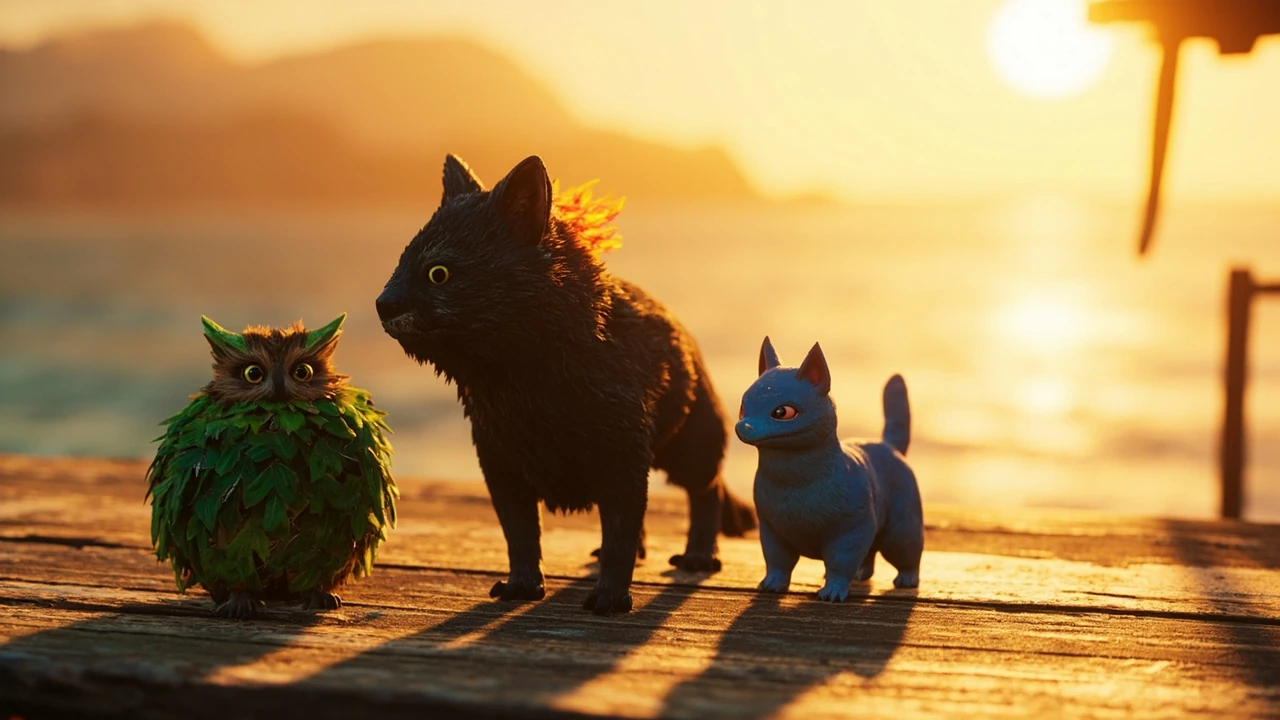
Pokemon Sun and Moon starters: what your choice actually changes
The first decision in Pokemon Sun and Moon is a familiar one: pick a starter. The Pokemon Sun and Moon starters are the grass-type Rowlet, the fire-type Litten, and the water-type Popplio, and each one shapes the first hours of the Alola region in small but noticeable ways. The choice is permanent in a single playthrough without trading, so it pays to know what you are committing to before the screen prompts you to choose.
Rowlet evolves into Dartrix and then Decidueye, a grass- and ghost-type sniper that favors ranged attacks. Litten becomes Torracat and then Incineroar, a fire- and dark-type wrestler built around physical hits and momentum swings. Popplio becomes Brionne and then Primarina, a water- and fairy-type performer whose strength is special attacks and supportive crowd control. None of them is strictly better than the others; they differ in tempo, coverage, and how comfortable they feel in a young trainer’s hands.
This guide focuses on practical differences rather than nostalgia. It walks through each starter’s design intent, the battle role each evolution fills, the type matchups you will lean on across the main story, and the production-side decisions that make Alola’s opening hours feel different depending on which creature you take out of Professor Kukui’s bag.
How Sun and Moon redesigns the starter formula
Generation VII did not just swap typings. The Alola games rebuilt the opening hours around region flavor, the island challenge, and a slightly slower early curve. That context matters when comparing the Pokemon Sun and Moon starters, because each one was tuned against the same new template.
- Trials instead of pure gym runs: the first three island captains give themed Totem Pokemon battles, so your starter is more important than usual for breaking early defensive walls.
- No HMs in the traditional sense: Poké Ride replaces HMs, which removes a historical reason to pick a specific water-type for Surf or a flying-type for Fly.
- Regional forms: the new Alolan forms around you change which classic typings are easy or hard to face, especially in the first island.
- Shorter mid-game: there are fewer mandatory gym-like buildings, so your starter’s movepool matters from the first route rather than from the mid-game onward.
- Shared experience: Exp. Share is built in from the start, so your bench grows quickly and your starter does not have to solo the early game.
Those changes mean the Pokemon Sun and Moon starters compete on personality, type, and battle feel rather than on which one covers the most HMs. The choice is closer to choosing a protagonist archetype than picking a utility role.
The three Pokemon Sun and Moon starters at a glance
Before going deeper, a quick comparison helps anchor the rest of the article. The table below summarizes the core attributes each player weighs at the moment of choice.
| Attribute | Rowlet line | Litten line | Popplio line |
|---|---|---|---|
| Base form | Rowlet | Litten | Popplio |
| Stage 1 evolution | Dartrix | Torracat | Brionne |
| Final evolution | Decidueye | Incineroar | Primarina |
| Types | Grass, Ghost (final) | Fire, Dark (final) | Water, Fairy (final) |
| Offensive bias | Physical / ranged | Physical / wrestling | Special / performing |
| Defensive bias | Moderate, evasion-leaning | Bulk and utility moves | Bulk and utility moves |
| Signature flavor | Archer that snipes from a distance | Brawler that builds momentum | Performer that controls tempo |
| Early island challenge fit | Strong into Melemele grass trials | Strong into Akala fire and dark coverage | Strong into Akala water and fairy coverage |
These traits are not just flavor. They shape which routes feel safe, which Totem Pokemon feel threatening, and which team compositions are easy to assemble around a single anchor.
Rowlet: a patient, ranged grass starter
Rowlet is a small grass- and flying-type owl that hides in its trainer’s bag and only reveals itself at Professor Kukui’s lab. It is the most relaxed of the three Pokemon Sun and Moon starters on screen, and that patience is reflected in how the line plays in battle. Rowlet evolves into Dartrix at level 17 and then into Decidueye at level 34, gaining the Ghost type on the final stage and a movepool built around long-range sniping rather than head-on trades.
Decidueye’s defining mechanic is its Hidden Ability, Long Reach, which lets it use its signature move Spirit Shackle without making contact. Spirit Shackle is a physical Ghost-type attack that also prevents the target from switching out, so Decidueye is positioned as a single-target lock that punishes opponents who try to rotate. That role is rare among grass starters, which usually lean on status or support.
For an Alola playthrough, Rowlet is at its strongest in the early mid-game. The first island, Melemele, has grass trials, Yungoos, and slowpokes that Decidueye handles comfortably. The first Totem Pokemon, Totem Raticate, can be dispatched with a mix of Spirit Shackle and standard grass coverage. By the time the player reaches Akala and then Ula’ula, Decidueye’s Ghost typing gives it useful answers against psychic and ghost targets, while keeping its grass half relevant against water, rock, and ground.
Where Rowlet is less smooth is against steel, fire, and fast offensive teams. Decidueye is not a tank and its speed tier is mid-range, so an opponent that pressures it before it can set up often forces a switch. Players who like a careful, positional style will feel right at home. Players who want a front-line brawler will probably feel friction.
Litten: a brawler that learns to dominate
Litten is a black fire-type cat with red eyes and a permanent scowl. It is the most combative of the Pokemon Sun and Moon starters in personality, and the line is designed around that energy. Litten becomes Torracat at level 17 and Incineroar at level 34, adding the Dark type and shifting the design from a focused striker into a flamboyant wrestler who uses the battlefield as a stage.
Incineroar is the most unusual choice of the three for a fire starter. Instead of the traditional “fast special attacker” role, it leans on physical attacks and a mix of fire and dark coverage. Its signature move, Darkest Lariat, is a strong Dark-type hit that ignores the target’s stat boosts, which gives it real value against setup sweepers. It also learns Flame Charge for speed control, Thunder Punch and Earthquake through the usual tutoring channels, and supports teammates with Intimidate on switch-in thanks to its Hidden Ability.
For the Alola main story, Litten is strongest on Akala Island, where the second Totem Pokemon, Totem Wimpod, and the fire and dark trials reward a hard-hitting physical attacker. By the late game, Incineroar’s typing and Intimidate let it pivot into physical attackers, soften them, and hand turns to a teammate, which is a niche that fits Sun and Moon’s trial-based pacing very well. Its slow growth curve and mid-range speed also mean it does not need constant cleanup; it is a setup and punish fighter.
The trade-off is timing. Incineroar is not as strong in the very first routes as a faster special attacker would be, and its evolution timing means Torracat carries a lot of the early island challenge. Players who enjoy a heavy, momentum-based character that grows into its role rather than starting as a glass cannon tend to enjoy Litten most.
Popplio: a performer that controls tempo
Popplio is a sea lion that balances a ball on its nose and bubbles out of its mouth like a clown. Of the Pokemon Sun and Moon starters, it is the most expressive in animation, and its line is built around that performance angle. Popplio becomes Brionne at level 17 and Primarina at level 34, gaining the Fairy type on the final stage and a stat spread that favors special attack and special defense.
Primarina’s identity is a special attacker that also supports the team. Its signature move, Sparkling Aria, is a water-type attack that heals the burns it inflicts, and it learns Moonblast naturally as it levels, giving it strong fairy-type coverage against dragons, fighters, and darks. The Hidden Ability, Torrent, boosts its water moves when it is low, which makes Primarina dangerous to take down in clutch moments. Its unique combination of Water and Fairy is rare in the game and lets it answer ice, fire, fighting, ground, and dragon matchups without needing complex team support.
In the Alola campaign, Popplio is excellent on Akala Island, where the water and fairy trials and Totem Wimpod ask for special bulk and clean hit timing. On Ula’ula, Primarina’s fairy half is useful against the dark-themed Totem and a number of ghost opponents. Its higher special defense stat also helps it survive the special attackers it tends to draw in.
Where Popplio can feel slow is on Melemele Island, where the early grass and normal-type trials reward a more physical early game, and against fast physical walls that force it to take hits. Players who like a calm, rhythm-based style, with strong support and a clear elemental identity, will enjoy the line. Players who want raw power up front will sometimes feel that Brionne asks for patience.
How each starter fits the Alola story arc
The Alola region is structured around four islands and the player’s choice of a starter, and each starter maps to a different comfort zone across that arc. The table below summarizes where each line tends to peak and where it needs help.
| Story phase | Rowlet line | Litten line | Popplio line |
|---|---|---|---|
| Routes 1 to 3 (Melemele) | Strong, grass and flying answers most early fights | Average, fire hits a mixed early roster | Average, water is good but grass and normal lead the early game |
| First Totem (Raticate) | Excellent, Spirit Shackle and grass coverage close the fight | Good, fire coverage handles Raticate and Yungoos | Good, water coverage and bulk help |
| Akala trials (second island) | Good, ghost half adds answers but speed falls behind | Strong, fire and dark answer Wimpod and the fire trial | Strong, water and fairy answer Wimpod and the water trial |
| Ula’ula trials (third island) | Strong, ghost half answers the dark and ghost themes | Good, dark and fire answer most of the trial lineup | Strong, fairy half answers dark, fighting, and dragon threats |
| Final island and league | Comfortable, ranged role fits the team-based Elite Four | Comfortable, Intimidate pivots help in long fights | Comfortable, special bulk and coverage help in drawn-out fights |
This is a soft fit, not a hard rule. The built-in Exp. Share means a single bench member can carry a phase that the starter does not, so a player who likes a particular line should not feel locked out of a section.
Type matchups that matter in early Alola
Sun and Moon’s first three islands have a clear type identity, and the Pokemon Sun and Moon starters each have a slightly different way of handling that identity. The lists below highlight the most common matchups a new player will face.
- Rowlet matchups to know: strong into water, rock, ground, and grass opponents. Weak into fire, ice, flying, dark, ghost, and steel. Spirit Shackle and Leaf Blade cover most of the favorable matchups.
- Litten matchups to know: strong into grass, ice, steel, and dark. Weak into water, ground, fighting, and rock. Darkest Lariat and Fire-type coverage are the workhorse moves.
- Popplio matchups to know: strong into fire, ground, rock, fighting, dragon, and dark. Weak into grass, electric, and poison. Sparkling Aria and Moonblast handle the favorable side cleanly.
These are not exhaustive, but they explain why each starter feels right at home in a different slice of the campaign. A new player who has seen a few spoilers about the first Totem battles can plan a starter choice around the early matchups they care about.
Production and design notes for the Alola starters
From a game design angle, the three Pokemon Sun and Moon starters are interesting because each one leans on a different combat archetype. The development team used the starter choice to set the player’s expectations for how the rest of the team should feel.
Rowlet was designed as a calm, ranged character. Its signature move, Spirit Shackle, and the Hidden Ability Long Reach push the player toward positional play, picking a target and pinning it down. That is reinforced by its visual design: a small owl that quietly tucks into a trainer’s bag before choosing to fight. The line is meant to feel like a careful, deliberate option.
Litten was designed as a brawler with attitude. The final evolution, Incineroar, is explicitly built like a professional wrestler, complete with a fire belt and a heel-style personality. Its movepool mixes fire and dark coverage, its Hidden Ability Intimidate debuffs opponents on switch-in, and its bulk lets it take hits while it sets up. The line is meant to feel like a heavy, momentum-based character that turns a fight around rather than winning cleanly at the start.
Popplio was designed as a performer with a support identity. Primarina’s Sparkling Aria, its fairy typing, and its high special defense all push the player toward a sustained, team-oriented style. The visual design, full of graceful water choreography, supports that role. The line is meant to feel like a calm anchor that the rest of the team can work around.
Those design intents also explain why the type matchups feel so even. The team tuned the typing, movepool, ability, and stat spread of each final evolution so that none of them strictly outclasses the others at the campaign level. The game does not pick a favorite; it asks the player to pick a style. A useful external overview of the regional mechanics and the type chart can be found on the Pokémon Sun and Moon Wikipedia article, which goes into more depth on the regional design and the role of each starter.
How the Pokemon Sun and Moon starters compare in late-game use
By the post-game, all three starters can serve in the Battle Tree, in online rated battles, and in casual competitive formats. They do not all serve in the same way. The list below summarizes their most common roles in those formats.
- Decidueye: a mid-speed choice user and pivot breaker, valued for its signature move and ability to lock a single target while supporting the team with Swords Dance or a coverage move.
- Incineroar: a slow pivot with Intimidate, frequently used to soften physical attackers, set up Fake Out pressure, and hand turns to faster sweepers.
- Primarina: a bulky special attacker, often built around Calm Mind or Choice Specs to leverage its unique Water and Fairy coverage and to provide a consistent answer to dragons and fighters.
None of the three is dominant in modern competitive formats on its own, but each has carved out a niche. A player who wants to extend their starter’s usefulness into the Battle Tree will find more success by building around one of these roles than by trying to force the starter into a generic sweeper build.
Who each starter fits best
Starter choice is partly taste, but there is a pattern to the kind of player each line rewards. The list below groups the Pokemon Sun and Moon starters by play style preference, with no ranking implied.
- Rowlet fits a player who likes positional play, ranged sniping, and a calm pace, and who is comfortable switching a starter in and out to manage matchups.
- Litten fits a player who likes physical hits, momentum swings, and a heavier, wrestler-style character that grows into a role rather than starting as one.
- Popplio fits a player who likes special attacks, supportive team play, and a clear elemental identity that the rest of the team can be built around.
Players who are returning to the series after a long break tend to find Rowlet the most familiar, because its grass typing and ranged flavor are easy to slot into a standard team. Players who have followed competitive formats for a while often lean toward Litten or Popplio, because their final evolutions have clearer niches in team support and pivoting. Players who are new to the franchise usually find Popplio the most forgiving, because its special bulk and fairy typing absorb more early mistakes than the other two lines.
Practical checklist before you choose
If you are still on the fence about which of the Pokemon Sun and Moon starters to pick, a short pre-choice pass can keep the decision from feeling rushed. The list below is the kind of pass that a player can run in the first ten minutes of the game.
- Decide which combat archetype you enjoy most: ranged physical, heavy physical, or supportive special. The starter that matches that archetype will feel natural the fastest.
- Look at the early route list. If you know there is a water trial coming up first, Popplio and Litten will both feel strong. If the first big fight is a grass-themed trial, Rowlet will feel especially comfortable.
- Check your planned team. A grass anchor, a fire anchor, or a water anchor each pulls a different secondary team. If you already have a strong fire-type planned, picking Litten will lead to overlap.
- Pick the personality that you will enjoy for sixty hours. A starter stays on the team for the entire main story, so animation, idle behavior, and cries matter more than they look on a stats page.
- Confirm that you have not accidentally read a heavy spoiler for the starter’s signature move or Hidden Ability. Going in blind usually makes the first evolution feel more rewarding.
None of these steps is required, but together they make the choice feel deliberate rather than reflexive. The starter you pick does not lock the rest of the game, but it sets the tone for the first ten hours, and that is worth a few minutes of thought.
Common myths about the Pokemon Sun and Moon starters
Because the Alola starters are popular, a few claims about them circulate more often than the facts support. The list below addresses the most common ones.
- Rowlet is the easiest starter: it is easiest on Melemele Island, but the late game demands a more deliberate play style. There is no single easiest starter across the whole campaign.
- Litten is weak in the early game: it is slightly slower to come online than Rowlet, but its fire and dark coverage line up well with the Akala trial roster, where the second island lives.
- Popplio is only for fairy fans: its water typing carries most of the early and mid-game, and the fairy type is a late addition that gives it strong utility rather than dominating the line.
- The Hidden Ability changes everything: Hidden Abilities matter, but they require either a special encounter or a post-game transfer. The base abilities are enough for the main story.
- Picking a starter decides your rival: the rival’s starter is the one with a type advantage over yours, but the rival’s team grows independently of the player’s, so the choice does not lock the rest of the campaign.
These are not corrections so much as reminders that the design of the Pokemon Sun and Moon starters is balanced around the whole campaign, not around a single moment.
How reception has shaped the starters’ reputation
Sun and Moon received a broadly positive critical reception, and the Pokemon Sun and Moon starters were often highlighted as one of the strongest starting trios in the series. Reviewers pointed to the personality animation, the clear type identity, and the way each line carved out a different combat niche. A useful aggregate view of the reviews, including how the three starters were received individually, is available on the pokémon sun and moon reviews – opencritic page, which collects critic scores and short summaries in one place.
Two patterns stand out in that reception. First, the design team was credited for giving each starter a clear, distinct combat identity without breaking the type triangle. Second, the Hidden Abilities and signature moves were seen as a way to make the choice feel important without forcing a competitive build. For a player who is choosing for the first time, that reception is a quiet signal that no choice is wrong. Each of the Pokemon Sun and Moon starters is meant to be a complete experience rather than a stepping stone.
Where the starter choice ends and the team begins
Even with a strong starter, a single Pokemon cannot carry the Battle Tree, the Elite Four, or the post-game. The starter is the anchor, and the rest of the team is built around it. The list below summarizes the kinds of teammates that pair well with each line in a standard Alola playthrough.
- Rowlet team: a strong physical attacker, a special wall, and a steel or fairy support Pokemon. A fast ground-type or a pivoting Incineroar can take some of the fire matchups that Rowlet struggles with.
- Litten team: a strong special attacker, a fast revenge killer, and a fairy or water support to cover Incineroar’s weaker matchups. A Primarina on the same team is a common answer to dragons.
- Popplio team: a strong physical attacker, a steel-type pivot, and a ground or electric answer to handle the electric and grass matchups that Popplio draws in.
The built-in Exp. Share makes those team compositions easy to keep up to level with the starter, so the second and third Pokemon can specialize without dragging the run down. For a player who wants a balanced first run, picking a starter that leaves an obvious gap on the team is often more useful than picking the one with the most raw power.
Final thoughts on the choice
The Pokemon Sun and Moon starters are not a ranked list. They are three carefully balanced characters that ask the player to pick a style rather than a stat. Rowlet is a patient ranger, Litten is a wrestler, and Popplio is a performer, and each one is balanced against the same Alola campaign. The right choice is the one whose personality and combat feel you can enjoy for the full length of the main story, because the starter will spend the most time on screen, in the menu, and in the small moments between battles.
Pick the one whose idle animation you want to see on every route. The rest of the run will take care of itself.
Frequently asked questions
Which of the Pokemon Sun and Moon starters is the best for beginners?
For a first run, Popplio tends to be the most forgiving of the three. Its final evolution, Primarina, is a bulky special attacker whose water and fairy typing answers a wide range of opponents. It also absorbs early mistakes better than the other two, because its special defense stat is high and its movepool gives it stable answers to several early trials. That said, any of the three is workable for a first run, because the built-in Exp. Share keeps the rest of the team within one level of the starter.
Can I get all three starters in one game?
You can only choose one as your starter in a single playthrough. The other two are not available in the same save file without trading, and the game does not give the player a second starter under normal conditions. The standard workaround is to start a new save and pick a second starter, or to use trade with another copy of the game.
Which starter has the best Hidden Ability?
Each Hidden Ability supports a different role. Long Reach on Decidueye lets it use Spirit Shackle without making contact, which is useful in single-target lockdown strategies. Intimidate on Incineroar softens physical attackers on switch-in, which is a strong support option in team play. Torrent on Primarina boosts its water moves when it is low on health, which rewards clutch plays. The best one depends on the team, not on a single number.
Do the starters matter for the post-game Battle Tree?
Yes, but none of them is dominant on its own. Decidueye, Incineroar, and Primarina each have viable Battle Tree sets, and each one needs a supporting team to clear the longer streaks. The starter you choose does not lock you out of the Battle Tree, and many successful runs use one of the three as an anchor rather than as a solo sweeper.
Which starter has the easiest time with the first island?
Rowlet has the easiest time on Melemele Island. The grass and flying coverage lines up with the early routes, and its evolutions handle the first Totem Pokemon cleanly. Litten and Popplio are also strong, but they do not match the first island’s roster as directly as Rowlet does.
Are the Pokemon Sun and Moon starters available in Pokemon Bank?
Yes, the three starters can be transferred to Pokemon Bank and then to later games, with the usual compatibility caveats for Hidden Abilities, moves, and held items. The transfer is one-way, so a player who wants to bring a starter forward should plan the move list and ability before sending it to Bank.
Which starter has the best signature move?
All three signature moves are useful, but they serve different roles. Spirit Shackle is a strong physical Ghost-type move that prevents the target from switching, which gives Decidueye a unique lockdown option. Darkest Lariat is a Dark-type move that ignores the target’s stat boosts, which gives Incineroar a clean answer to setup sweepers. Sparkling Aria is a Water-type move that heals burns, which gives Primarina a useful tool in long fights. The best signature move is the one that fits the team the player is building.
What level do the starters evolve?
All three starters evolve at the same levels. The first evolution happens at level 17 and the second at level 34, regardless of which starter is chosen. That timing is part of why the Pokemon Sun and Moon starters feel balanced against each other: their stat growth and move access are on the same schedule.





Leave a Reply