

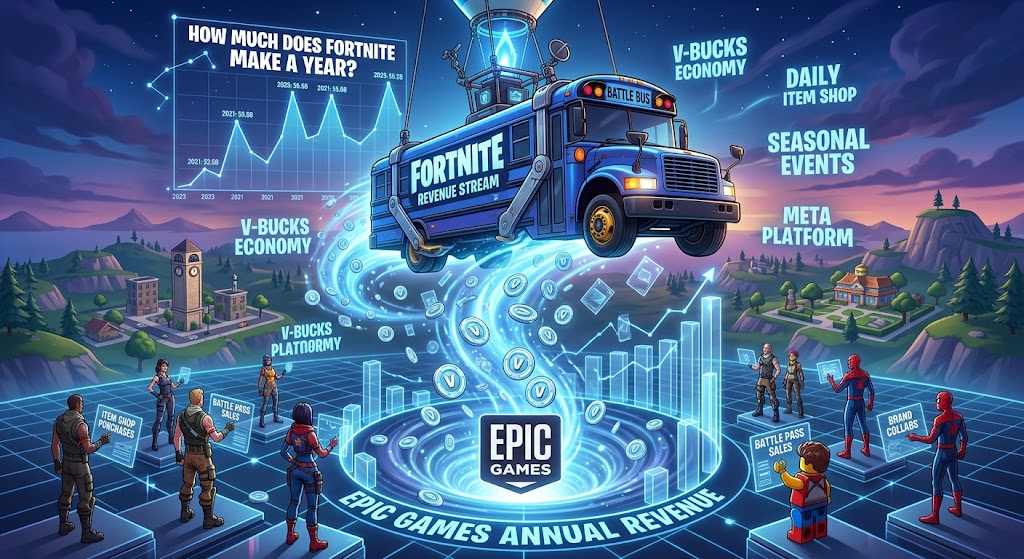
How Much Does Fortnite Make a Year?
If you have ever landed at Tilted Towers, survived a chaotic endgame in Pleasant Park, or jumped out of the Battle Bus with your squad, you already know that Fortnite is far more than just a typical video game. It is a massive, living cultural phenomenon that has redefined online social spaces for an entire generation. But beyond the flashy character skins, viral dance emotes, and high-stakes battle royale matches lies one of the most impressively engineered money-making machines in the history of interactive entertainment.
Many curious gamers, industry analysts, and tech enthusiasts often ask: how much does Fortnite make a year? The overall figures are completely mind-boggling, especially when you step back and remember that the game costs absolutely nothing to download, install, and play from start to finish.
In this comprehensive financial deep dive, we are going to unpack Epic Games’ massive digital empire. We will explore annual earnings trends, cosmetic item economics, battle pass mechanics, corporate crossover deals, and how free-to-play monetization seamlessly converts casual gamers into passionate, lifelong paying customers.
Why How Much Does Fortnite Make a Year Matters
Understanding exactly how much does Fortnite make a year gives us a fascinating window into modern gaming economics and shifting consumer behavior. Decades ago, the video game industry relied almost entirely on traditional $60 physical boxed releases sold on retail store shelves. Once a customer bought the disc, the financial relationship between the player and the publisher was largely finished. Fortnite completely dismantled and rebuilt that old business model from the ground up.
By offering its main Battle Royale game mode as a totally free download on virtually every modern device, Epic Games opened the floodgates to hundreds of millions of eager players around the world. There was no financial barrier to entry, which allowed the player base to grow exponentially through word-of-mouth and social momentum. Once millions of gamers settled comfortably into the game’s ecosystem, thoughtful microtransactions were introduced in a way that felt entirely natural and non-intrusive.
This brilliant strategy instantly propelled Epic Games into the upper echelon of tech powerhouses while fundamentally altering consumer expectations. It proved conclusively that modern players are more than willing to spend real, hard-earned money on purely cosmetic digital items that deliver zero competitive gameplay advantages, provided the core game remains fun, high-quality, and constantly updated.
Let us take a detailed look at the estimated annual earnings breakdown across recent years to better understand how this financial trajectory developed over time.
| Year | Estimated Annual Revenue | Primary Financial Drivers & Events |
|---|---|---|
| 2018 | $5.4 Billion | Explosive global takeoff, Season 3-7 Battle Passes, Ninja and Drake Twitch stream hype |
| 2019 | $3.7 Billion | Inaugural Fortnite World Cup, Marshmello live concert event, initial Marvel crossovers |
| 2020 | $5.1 Billion | Global stay-at-home gaming boom, record-breaking Travis Scott concert, Chapter 2 expansion |
| 2021 | $5.8 Billion | Ecosystem monetization maturity, endless IP collaborations, Fortnite Crew subscription launch |
| 2022 | $6.0 Billion | Zero Build mode launch, Dragon Ball, Anime & Star Wars brand partnerships |
| 2023 | $6.5 Billion | Fortnite OG nostalgic season surge, launch of Lego Fortnite, Rocket Racing, and Festival modes |
When you examine these yearly revenue numbers, the most striking pattern is the astonishing consistency of the title. While many viral hit games experience a quick surge in popularity followed by a steep and irreversible decline, Fortnite has managed to sustain multi-billion-dollar annual revenues for well over half a decade without missing a beat.
How Fortnite Generates Billions Every Single Year
So where does all this cash actually come from on a day-to-day basis? Because players never have to spend a single cent to stay competitive or win matches, Epic Games relies on clever monetization design that feels entirely optional, completely fair, and yet practically irresistible to active community members.
Here are the primary revenue streams that fuel this massive commercial ecosystem:
- V-Bucks Digital Currency: The foundational fuel of the entire in-game economy, allowing players to exchange real-world fiat currency for virtual cash used across all shop purchases.
- Seasonal Battle Pass System: A hugely popular seasonal progression ticket costing roughly $9.50 that rewards continuous playtime with exclusive thematic cosmetics and extra bonus V-Bucks.
- Brand Collaborations and Crossovers: High-profile licensing deals with major entertainment conglomerates like Disney, Marvel, DC Comics, anime studios, and global sports franchises.
- Fortnite Crew Subscription Service: A monthly recurring subscription plan that provides members with exclusive outfits, monthly V-Bucks allowances, and automatic access to current Battle Passes.
- Creator Ecosystem and Creative Islands: Monetization structures supporting user-generated game modes, keeping players immersed inside custom experiences without ever leaving the Fortnite client.
The virtual Item Shop updates every single evening like clockwork at 00:00 UTC. This continuous daily refresh mechanic creates a powerful psychological sense of urgency, often referred to as FOMO, or the fear of missing out.
When a popular movie character, musician, or anime hero appears in the store today, players know that item might vanish tomorrow and not return to the rotation for several months or even years. That subtle time pressure drives significant impulse spending across every gamer demographic.
And the numbers prove how effective it really is. Millions of passionate players routinely top up their V-Buck balances specifically so they can grab the newest skin, pickaxe, glider, or dance emote the moment it goes live in the digital store.
To truly appreciate the sheer scale of these annual earnings, it helps to see how Epic Games compares against other major free-to-play titans currently operating in the live-service gaming market.
| Game Title | Developer / Publisher | Average Annual Revenue | Core Monetization Strategy |
|---|---|---|---|
| Fortnite | Epic Games | $5.5B – $6.5B | Cosmetic Skins, Battle Passes, Monthly Subscriptions |
| Roblox | Roblox Corporation | $2.2B – $2.8B | Robux Currency, Developer Exchange, Avatar Marketplace |
| Genshin Impact | miHoYo / HoYoverse | $2.0B – $3.0B | Gacha Character Banners, Energy Refills, Battle Pass |
| Call of Duty: Warzone | Activision Blizzard | $1.5B – $2.0B | Battle Pass Bundles, Weapon Blueprints, Operator Packs |
| Apex Legends | Electronic Arts / Respawn | $1.0B – $1.3B | Apex Packs, Heirloom Events, Battle Pass Seasons |
As the comparison table clearly demonstrates, Epic Games operates on an enviable level of commercial success that few rival studios can ever hope to mirror. The sheer frequency and scale of content drops keep the revenue stream flowing smoothly week after week, month after month.
Another major advantage working in Fortnite’s favor is universal hardware accessibility. The game is seamlessly available across Windows PCs, PlayStation, Xbox, Nintendo Switch, Android devices, and cloud streaming platforms on iOS. You can play with your friends regardless of what device they happen to own.
This complete cross-platform connectivity means your cosmetics, stats, and progression follow your Epic Games account wherever you go. If you unlock a sleek new skin on your gaming rig at home, you can show it off while playing a quick match on your mobile phone during lunch break or on a commute.
Here are several core reasons why players willingly choose to spend money inside the game year after year:
- Personal Digital Identity: Skins and outfits function as modern social status symbols and personal identity markers within pre-game lobby groups and squad matches.
- Pop Culture Convergence: Stepping onto the island as Spider-Man, Goku, Master Chief, or Lady Gaga bridges the gap between interactive gaming and global pop culture fandom.
- Unmatched Live Event Spectacles: End-of-season story events bring together tens of millions of concurrent live viewers for shared, cinematic gaming moments.
- Relentless Gameplay Evolution: Weekly unvaulting of items, drastic map terraforming, new movement mechanics, and fresh weapon meta shifts keep the core game infinitely replayable.
Furthermore, Fortnite is no longer just a single battle royale mode. The ambitious additions of Lego Fortnite, Fortnite Festival, and Rocket Racing have officially transformed the application into a massive, multi-genre gaming metaverse platform.
This strategic expansion means Epic Games is no longer relying on a single gameplay loop to maintain player interest. Gamers who feel burned out on competitive battle royale matches can instantly pivot to open-world survival crafting or music rhythm challenges without ever closing the application.
Here is why this platform-first strategy guarantees long-term financial health for the company:
- Dramatically Higher Player Retention: Giving gamers multiple distinct genres under one launcher keeps daily active user metrics exceptionally high over long spans of time.
- Broader Audience Demographics: Lego Fortnite attracts younger survival crafting fans, while Fortnite Festival appeals directly to music lovers and rhythm game enthusiasts.
- Interoperable Cosmetic Value: Purchases made in one game mode often translate seamlessly into usable assets across other modes, significantly boosting the perceived value of every V-Buck spent.
When you combine these powerful economic pillars, it becomes easy to see why annual revenue metrics consistently land in the multi-billion-dollar range. Epic Games has constructed an adaptable, future-proof entertainment ecosystem that thrives regardless of broader gaming industry shifts.
Frequently Asked Questions
How Much Money Does Fortnite Make a Day?
On average, Fortnite generates between $12 million and $18 million every single day depending on current in-game events, shop inventory rotations, and seasonal schedules. During major chapter updates, brand collaboration drops, or holiday events, daily earnings frequently surge past $20 million per day.
Is Fortnite Still Profitable in 2026?
Yes, Fortnite remains extraordinarily profitable and continues to stand as one of the most lucrative intellectual properties in the entire digital entertainment market. Its successful evolution into a multi-game metaverse featuring user-generated content ensures robust financial growth and high player retention year after year.
How Many Active Players Play Fortnite Annually?
Fortnite boasts over 500 million registered player accounts globally across all platforms. The game consistently maintains a healthy monthly active user base ranging between 70 million and 100 million players, with peak concurrent player counts regularly surpassing 10 million during major live events and seasonal launches.
How Much Revenue Does the Fortnite Battle Pass Generate?
The Battle Pass system generates hundreds of millions of dollars each individual season. With roughly four to five distinct seasons launched per calendar year and tens of millions of active Battle Passes purchased per season at $9.50 each, this single mechanic provides a massive financial foundation for Epic Games.
How Much Does Epic Games Make from Fortnite Cosmetics?
In-game cosmetic sales, including character outfits, harvesting tools, gliders, wraps, and dance emotes, represent over 80% of total annual Fortnite revenue. Players worldwide spend billions of dollars each year purely on visual personalization items that do not offer any competitive performance benefits.
Does Fortnite Make Money on Mobile Platforms?
Yes, Fortnite continues to earn substantial revenue from mobile users worldwide. Although legal battles affected traditional app store availability in certain territories, cloud gaming services like Xbox Cloud Gaming and GeForce NOW alongside direct Android installations keep mobile player engagement and microtransaction revenue thriving.
How Much Money Has Fortnite Made in Total Lifetime Earnings?
Since its original release in 2017, Fortnite has generated well over $30 billion in cumulative total gross revenue. This staggering financial achievement places it firmly among the highest-grossing entertainment franchises, media properties, and video games in modern history.
In summary, examining how much does Fortnite make a year reveals an absolute financial titan that continues to lead and reshape the digital entertainment industry. Generating between $5 billion and $6.5 billion in annual revenue, Epic Games has perfected free-to-play monetization through constant gameplay innovation, iconic pop culture partnerships, and a booming multi-genre metaverse. As Fortnite continues to push boundaries and welcome new generations of players, its annual earnings will undoubtedly remain at the top of the gaming industry for years to come.





Leave a Reply