

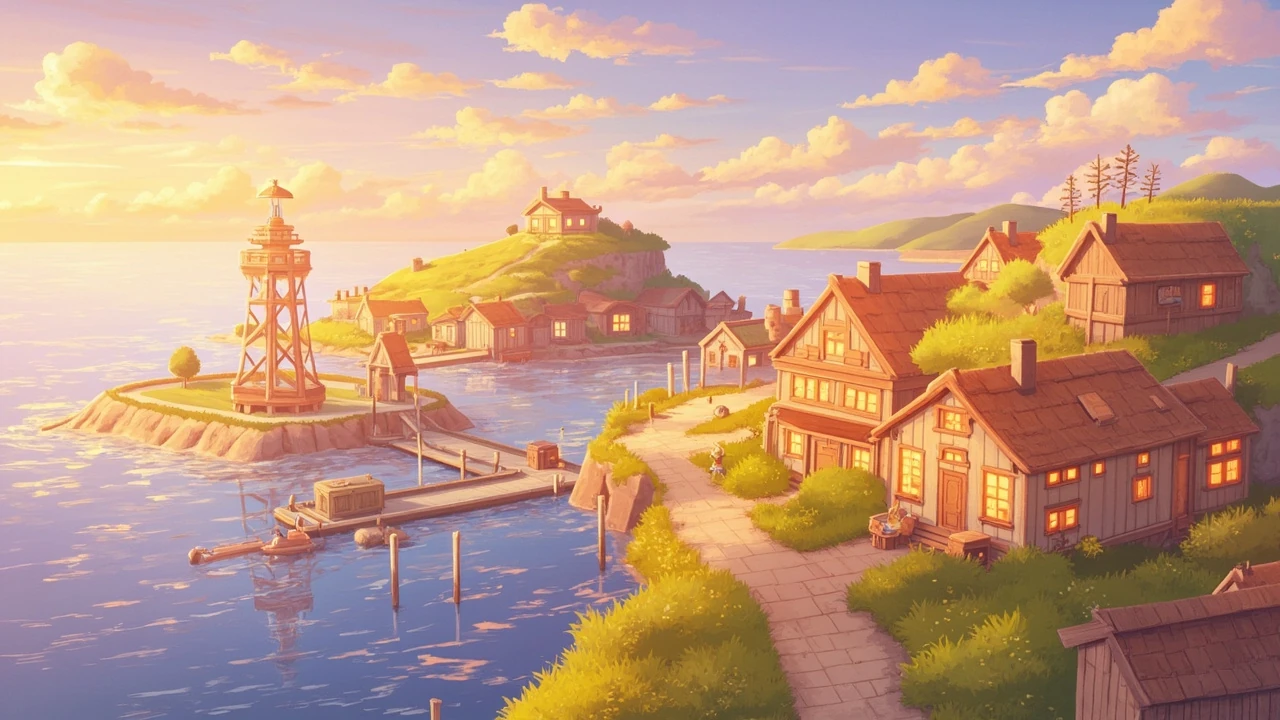
Pokopia dream island: what the concept is and how it works
A pokopia dream island describes a small, self-contained sandbox world built around low-pressure exploration, building, and gentle social play. The phrase shows up in discussions of cozy game design, life-sim prototypes, and short-form player guides for community-made islands in the style of Animal Crossing, Dreamlight Valley, and similar crafting-and-care titles. Players, hobbyist designers, and small studios use the term loosely, so the first job of this article is to separate the design meaning from the social media shorthand.
Context decides what the phrase actually points to. In some posts, pokopia is the working title of an in-development project. In others, it is a community nickname for a fan-made island layout. In still others, it is a generic label for any cozy island that feels like a personal retreat. This article treats the term as a design concept first, then explains how it shows up in real cozy games, including the systems that make a dream island feel different from a standard open-world level.
If you are searching for a specific game titled Pokopia or a specific island called Dream Island, the safer move is to verify the title on an official store page before trusting a third-party walkthrough. For designers and developers, the more useful exercise is to look at the mechanic set that the pokopia dream island concept is built on, because that set is what players recognize even when every visual and narrative detail changes between projects.
Where the pokopia dream island idea comes from
The phrase combines two design ideas that have been around for a long time. The first is the dream island, a small, hand-shaped map that a player can alter piece by piece. The second is a pokopia-style approach, which treats the world as a collection of pockets or biomes that the player moves between rather than a single continuous terrain. When the two are combined, designers usually arrive at a world that feels both personal and modular, with clear destinations and a strong sense of ownership.
Long-running examples of the dream island pattern include the island life simulations that Nintendo and similar studios have produced over the last two console generations, where the player’s home island is the central hub and other spaces act as satellite areas. Those satellite areas share many of the same design moves with the pokopia idea, including limited vertical scale, short traversal distances between landmarks, and a small set of must-visit nodes such as a shop, a crafting table, and a small social area. For background on the broader notion of dream islands as private sanctuaries, the Dream Island article traces how the phrase has been used in fiction and game design over time.
For a small team trying to build a pokopia dream island today, the practical starting point is not a feature list. It is a question of pacing: how much can a player do in a five-minute session and still feel that the world moved forward? That pacing constraint is what separates a cozy island from a generic small map with a crafting bench in the corner.
Core design pillars of a pokopia dream island
Most implementations of the pokopia dream island concept lean on the same handful of pillars, even when the art direction changes dramatically between projects. A team that is evaluating or building one should be able to point to each of these in the playable build.
- Personal terrain. The island belongs to the player in a literal sense. Terrain edits, decoration, and pathing choices persist and visibly shape future visits.
- Short traversal loops. Most activities can be reached within thirty seconds of fast travel or one minute of on-foot travel, so players never feel they are spending a session in transit.
- Soft progression. Tools, recipes, and social features unlock gradually, but nothing forces a player to chase a timer, a season, or a difficulty curve.
- Loopable daily beats. The island supports a comfortable daily rhythm, such as a morning check-in, a short task, and a closing activity, that players can repeat without fatigue.
- Light social presence. Visitors, neighbors, or passive NPCs provide company without requiring the player to manage complex social systems.
These pillars are diagnostic questions, not a recipe. If a prototype does not answer “where is the player’s personal terrain?” or “what is the daily loop?”, the design will feel generic even with excellent art and audio.
How a pokopia dream island differs from a standard open-world level
A standard open-world level usually asks the player to cross a large map, manage inventory across long distances, and tolerate downtime between objectives. A pokopia dream island instead compresses that map, accepts lower content density, and replaces long-range variety with a curated set of nodes. The trade-off is direct: designers give up world scale, and they get back session responsiveness, lower asset budgets, and a stronger emotional hook.
The contrast shows up in concrete numbers. A typical AAA open-world region might budget for several thousand unique props across a 4 km square area. A pokopia-style island usually ships with a few hundred props across a 200 m to 400 m area, but every prop is meant to be moved, placed, and revisited. That difference in density has consequences for art, audio, and engineering that are worth thinking through before a project starts.
| Design dimension | Standard open-world region | Pokopia dream island |
|---|---|---|
| Typical traversable area | 1 to 4 km square | 200 to 400 m across |
| Player activity per session | Quest or objective chains | Loops of care, build, and visit |
| Content density | High, spread across many biomes | Lower, concentrated on key nodes |
| Progression pressure | Map markers, timers, difficulty | Soft unlocks, optional goals |
| Memory and streaming budget | Aggressive streaming, LOD chains | Often fits in a single streaming cell |
| Player emotional hook | Discovery and mastery | Ownership and routine |
Teams that come from action or open-world backgrounds sometimes misread the pokopia dream island as a small version of a bigger design. It is not. The reduction in scale is only worthwhile if the freed production time is reinvested in personalization, accessibility, and a denser social layer. Without that reinvestment, the result is a small empty map.
Player loop and daily cadence in a pokopia dream island
The player loop is where the pokopia dream island concept becomes concrete. A short session usually starts with arrival, includes a couple of focused tasks, and ends with a small visible change. Over a week, those small changes accumulate into a recognizable personal world. Designers refer to this as a soft compounding loop because the player sees progress without the game imposing a hard milestone.
A typical daily loop on a pokopia dream island might look like the sequence below. Each beat is short, can be skipped without penalty, and leaves the world in a slightly different state than the player found it.
- Arrive and orient. A short camera move or a quick fast travel places the player at home base. The game gives a one-line summary of what changed since the last visit.
- Check core needs. Tools, crops, machines, and shop inventory are in a known state. The player decides what to top up.
- Run one focused task. For example, gather, craft, decorate, or visit a neighbor. The task fits in five to fifteen minutes.
- Place or adjust something. A path, a plant, a piece of furniture, or a sign. The change is visible to the player and to visitors.
- Close the session. Save state commits, a soft cue plays, and the world continues to advance on its own timeline.
This is the cadence that a lot of successful cozy life-sim titles converge on, regardless of whether they call themselves a dream island or a pokopia. If a design document cannot describe this loop in five steps, the team usually has not yet found the right scope.
Production cost and budget framing
From a production standpoint, a pokopia dream island is not automatically cheaper than a slice of open world. Smaller traversable area does not automatically mean smaller budget, because personalization, decoration catalogs, and the social layer each carry their own cost. The honest framing is that the cost moves rather than disappears.
For a small team, that trade often works in their favor. A short traversable area means fewer environment art assets, less streaming work, and a tighter QA surface. The cost that increases is in catalog content: how many decoration items, building pieces, and clothing options the player can use to make the island their own. A useful working ratio is to plan roughly one unique decoration or building piece for every ten minutes of intended playtime, and to keep that ratio consistent across early access and post-launch updates.
| Production area | Cost direction vs. open-world slice | Reason |
|---|---|---|
| Environment art | Lower | Smaller area, fewer biomes, fewer unique props |
| Streaming and memory | Lower | Often a single persistent cell |
| Decoration and building catalogs | Higher | Personalization is the core value |
| Audio and ambient beds | Similar | Short loop still needs day and night coverage |
| Social and persistence layer | Higher | Visit systems and shared state are not free |
| QA surface | Lower in geography, similar in systems | Fewer locations, more state combinations |
The numbers in this table are directional, not benchmarks. Real budgets depend heavily on team location, art style, and platform. The point is to plan for the catalog cost up front, because it is the most common place where a small cozy project quietly doubles its scope.
Technical systems that a pokopia dream island relies on
A pokopia dream island looks gentle, but it depends on a few technical systems that have to be designed carefully. The most important are terrain editing, save persistence, and the visit layer. Each one is a place where a small team can save time or lose it, depending on how early it is built.
Terrain editing and decoration grid
Terrain editing is the heart of the experience. The classic mistake is to expose a free-form mesh editor to the player, because free-form editing is expensive to validate and hard to keep performant on consoles and mid-tier mobile devices. Most cozy islands instead use a tile or chunk grid, where the player chooses from a finite palette of pieces and the game validates the placement against a small set of rules. That grid is also what makes saves cheap, because only the indices of placed tiles need to be written, not the geometry itself.
A practical tip: keep the grid resolution in meters consistent with the player’s intended pace. A 1 m grid is too fine for cozy pacing and produces visible seams in paths. A 4 m grid is too coarse for players who want to make curved gardens. Most teams settle between 1.5 m and 2 m for the main island terrain, with finer grids reserved for indoor rooms.
Save persistence and state separation
Save state has to be split into pieces that can be written and read independently. The classic split is into world state, player state, and meta state. World state covers the island’s terrain and placed objects. Player state covers inventory, currency, and progress unlocks. Meta state covers settings, friend lists, and account data. Writing world state separately means that a save failure on a decoration only risks that decoration, not the player’s progress, and the system can recover gracefully on the next launch.
From a production standpoint, the lesson is to design the world state format before any decoration catalog content is made. If the format is redesigned later, every catalog item has to be migrated, and the migration cost will eat the production savings the small map was supposed to deliver.
Visit, neighbor, and async social layer
The social layer is what turns a personal island into a pokopia dream island in the full sense. A common pattern is to treat visits as asynchronous: one player uploads a snapshot of their island, the host player downloads it on demand, and the visit happens locally without any live network session. That approach avoids the cost of running a dedicated server and the complexity of real-time synchronization, and it fits the gentle pace of the experience.
Two practical risks are worth flagging. The first is moderation: any user-generated content surface has to plan for report flows, takedown responses, and a small moderation budget. The second is asset budget: the visiting player downloads the host’s island as a separate scene, which means the catalog has to be shared between the two players, and any asset that is not shared will fail to render and can look like a save bug.
Art direction and audio for a pokopia dream island
Art direction is the most visible decision, but it is not where the experience lives. A pokopia dream island succeeds or fails on whether the art and audio support a calm, recognizable daily rhythm. The risk is to invest heavily in cinematic set pieces and forget the small, repeatable moments that the player actually experiences most often.
- Lighting. Lean on warm key lights and a soft sky. Avoid harsh contrast that fights with the cozy mood, especially in interior rooms that the player will see many times.
- Palette. Pick a base palette of three to four hues, then a smaller accent palette for seasonal events. Restricting the palette is what makes player-placed decoration feel like it belongs.
- Props. Aim for soft, slightly chunky silhouettes. Players will rotate and stack these, and complex silhouettes break at oblique angles.
- Ambient audio. Use a small set of looping beds per biome, with a soft day and night crossfade. Avoid stingers that play on every placement; they fatigue quickly.
- UI and iconography. Keep the UI flat, rounded, and quiet. Visual noise in the UI is felt across every minute of play, not just at key moments.
None of these are rules. They are defaults that successful cozy projects converge on. A team that deliberately breaks one should know which other system will pick up the slack.
Common design pitfalls when building a pokopia dream island
The concept is forgiving, but it is not trap-free. The pitfalls below are the ones that show up most often in prototypes, in early access launches, and in the first two post-launch content updates. They are framed as questions a team can ask of their own build before it ships.
- Empty starter island. If the player arrives to a blank map, they often leave before the first decoration drop. Pre-place a few clusters and a clear path so the island reads as a place, not a tool.
- Decoration without purpose. A catalog of purely cosmetic items loses appeal fast. Pair decoration with at least one soft mechanical use, such as comfort bonuses, neighbor reactions, or seasonal unlocks.
- Timer pressure. Any system that punishes a player for missing a day, such as a decaying crop or a limited event, can quietly break the cozy contract.
- Visit layer without feedback. If visiting a neighbor has no visible result on the host’s island, the social feature feels pointless. Plan at least one small, persistent change from a visit, such as a thank-you gift or a small decoration.
- Catalog scope creep. Adding decoration items is fun and visible, which is exactly why it is dangerous. Set a per-season catalog cap and treat it as a hard line.
These pitfalls are not absolute. Some successful projects deliberately add timer pressure, for example. The point is that each deviation should be a choice, not an accident.
Comparing the pokopia dream island concept to other cozy templates
The pokopia dream island sits inside a wider family of cozy templates. The table below compares it to three common neighbors: the single-shop life sim, the shared farm, and the open-ended creative sandbox. None of these is better than the others. They are answers to different player questions, and the right choice depends on the audience the team is trying to reach.
| Template | Core player question | Personalization depth | Social layer | Best for |
|---|---|---|---|---|
| Pokopia dream island | How do I make this place mine? | High on terrain and decoration | Async visits | Players who want a personal retreat |
| Single-shop life sim | How do I run this place well? | Medium, focused on the shop | Light, often NPC-driven | Players who enjoy management and routine |
| Shared farm | How do we share this place? | Medium, focused on co-op tasks | Live co-op | Players who want a small group project |
| Creative sandbox | What can I build here? | Very high, often unlimited | Sharing and browsing | Players who want pure creative expression |
A team that picks the pokopia dream island is implicitly picking the first row. The other templates are not wrong, but they make different promises, and the player who shows up for a personal retreat is not the same as the player who shows up for a management game.
Marketing and positioning a pokopia dream island project
Positioning is where many small cozy projects struggle, because the term itself does not appear on a store page. Instead, the project has to be described in plain language that matches what the player is searching for. That usually means three to five positioning pillars that the marketing site, store page, and trailer can all reference without contradicting each other.
- Audience pillar. Who is the player? A clear audience pillar is more useful than a broad “for everyone” claim, and it shapes the screenshots the marketing team picks first.
- Pace pillar. What does a typical session feel like? A claim of five-minute visits is stronger than a vague “play at your own pace”, because the player can plan around it.
- Ownership pillar. What does the player get to shape? If the answer is “everything”, the screenshots have to show that, not just a curated hero island.
- Social pillar. Who else shows up in the world, and how? The answer has to be honest. An async visit system is not the same as a co-op experience.
- Update pillar. What does the player get after launch? A short, clear roadmap is more convincing than a vague promise of future content.
These pillars also help internally. A design decision that contradicts a pillar should be flagged, because the marketing and design teams will end up fighting over it later if it is not caught early.
Player-side checklist for evaluating a pokopia dream island experience
For a player who is trying to decide whether a given game or community-made island fits the pokopia dream island idea, the checklist below is a fast way to evaluate before investing significant time. It is not a scoring system. It is a set of questions whose answers are usually obvious within the first session.
- Can I change the terrain or place objects in a way that persists between sessions?
- Is the daily loop short enough that a five-minute visit still feels like progress?
- Are the progression systems soft, or do I feel pushed toward a specific goal?
- Do I have a way to share or visit without committing to a long live session?
- Does the art and audio support a calm mood across an entire play session, not just the opening hour?
- Is the catalog of decoration and building pieces large enough to keep me interested for the time I plan to invest?
- Are the editing tools responsive enough that placing a single object does not feel like a chore?
If a project answers yes to most of these, the player is in the right genre for the concept. If several answers are no, the project is probably a different template wearing cozy clothes.
Frequently asked questions
Is Pokopia a real game or a concept?
It depends on the context. The safest move is to treat the phrase as a design concept that overlaps heavily with cozy life-sim templates. If a specific game is titled Pokopia, the only reliable confirmation is the official store page or the developer’s own site. Trailers, fan wikis, and community posts can describe a project in development, but they are not a release confirmation, and they sometimes refer to prototypes that change name before launch. When in doubt, search the developer name plus “official site” rather than trusting a screenshot.
What makes a dream island feel different from a regular small map?
The difference is the player’s relationship to the terrain. A regular small map is something the player moves through. A dream island is something the player edits and returns to. The mechanics that signal this are persistent terrain edits, a decoration or building catalog, and a save system that preserves those edits across sessions. Without at least two of those three, the map reads as a level, not as a personal world.
Can a small team realistically ship a pokopia dream island?
Yes, and the small map helps with several production risks. What usually surprises new teams is the cost of the decoration and building catalog, plus the social and persistence layer. A realistic plan keeps the team small, scopes the catalog to a clear per-season cap, and uses an asynchronous visit system rather than a live co-op server. With those choices, a small team can ship a focused first version and grow it through updates.
How long should a daily session in a pokopia dream island be?
Most successful cozy projects design for a five to fifteen minute core session, with optional stretch goals that take it up to thirty minutes. The reason is not just player preference. A short core session is what makes the daily loop feel like a routine, and a routine is what keeps players returning. If the shortest meaningful activity takes thirty minutes, the project is closer to a management sim than a pokopia dream island.
What engine is best for a pokopia dream island?
There is no single best engine. The honest answer is to pick the engine the team already knows, because the technical risks of a small cozy map are usually lower than the production risks of learning a new toolchain mid-project. That said, an engine with strong prefab workflows, a flexible grid system, and a friendly UI runtime tends to save time on the decoration and inventory layers. Switching engines to chase a feature is rarely worth it for a project of this scope.
How does monetization work without breaking the cozy mood?
The safest pattern is a base game with a clear price, plus optional cosmetic packs that match the art style and do not give mechanical advantage. Mechanics that sell time, energy, or progression tend to break the cozy contract because they create timer pressure the player did not ask for. A battle pass can work, but only if the rewards are cosmetic and the cadence is generous, so the player never feels punished for missing a week.
Is the pokopia dream island concept only for Nintendo-style games?
No. The concept is engine-agnostic and platform-agnostic. The reason it gets associated with Nintendo-style games is that several popular Nintendo-adjacent life sims use the dream island template, and that visibility shapes how players describe the genre. The same template shows up in mobile games, browser games, and PC-only projects, sometimes with very different art direction. A team building one is not copying a specific brand, they are working within a recognized design pattern.
What is the biggest risk for a first-time pokopia dream island project?
Catalog scope creep. It is easy to underestimate how much content the player expects from a personalization-driven game, and even easier to keep adding decoration pieces because each one is small and fun to make. The fix is a per-season cap, a clear retirement rule for older items, and a content calendar that protects engineering time. Without those guardrails, a project that started as a six-month build can quietly become a two-year build.
How do I tell a fan-made pokopia dream island from an official one?
Check the source. Official projects are listed on the developer’s verified channels, and they appear on a store page with a publisher and a release date. Fan-made islands are usually shared on community platforms, and they often reference a base game rather than standing on their own. A community island can be excellent, but it inherits the base game’s rules and updates, which is a real difference from a standalone title.
Where can I learn more about the design history of dream islands?
The Dream Island article on Wikipedia gives a useful starting point for the cultural and design history of the phrase. From there, the practical learning is to play several cozy life-sim titles, take notes on what feels rewarding and what feels like padding, and then map those observations back to a small design document for your own project. Reading alone is not enough. The pacing of the experience is something you internalize by playing.





Leave a Reply