

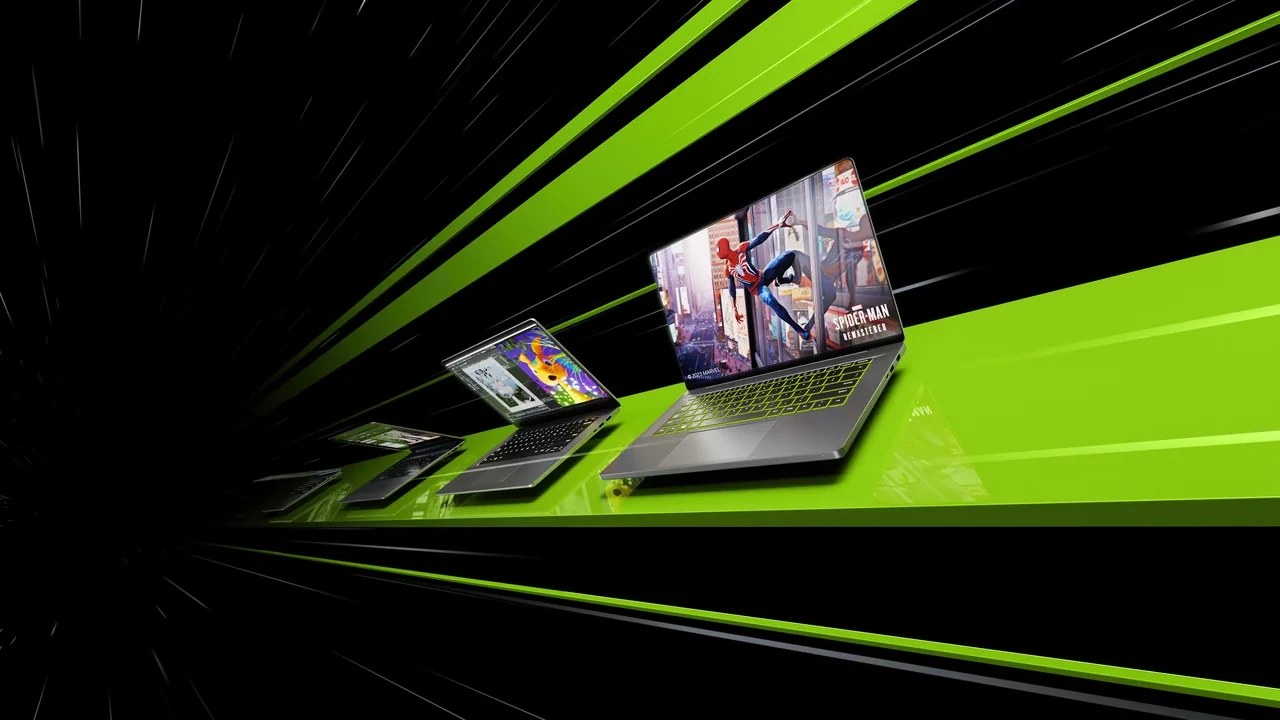
GeForce RTX 4060 Laptop GPU DLSS 5 compatibility: where things stand
NVIDIA has not announced DLSS 5 launch support for the GeForce RTX 4060 Laptop GPU. Its latest official feature set is DLSS 4.5 Super Resolution, Ray Reconstruction, and Frame Generation. Future support remains unknown until a driver note, SDK release note, or product-page update names this mobile GPU.
Developers should expose only the supported toggles and keep player messaging tied to NVIDIA’s device list. Rumors and unverified benchmarks are not a substitute for that record.
DLSS 5 support needs hardware, driver, and SDK agreement
DLSS 5 follows DLSS 4.5 in NVIDIA’s public numbering. The family includes Super Resolution for upscaling, Ray Reconstruction in place of hand-tuned denoisers, and Frame Generation between rendered frames. A new generation can change feature conditions or limit components to particular hardware.
The GPU must appear in NVIDIA’s supported list, the driver must enable the appropriate neural network, and the engine must use the exposing SDK. If any layer is missing, the title falls back to the highest version accepted by the installed runtime.
NVIDIA has often enabled DLSS by generation, but laptop drivers can trail desktop releases and mobile systems have tighter power and thermal budgets. A technically supported feature may still be a poor default on a constrained chassis.
The mobile RTX 4060 shares Ada, not desktop power limits
The laptop GPU belongs to the same Ada Lovelace family as the desktop GeForce RTX 4060 and uses the same generation of Tensor Cores and ray-tracing cores. OEMs define its power envelope, however, instead of one fixed board-power target.
Architecture may permit the same feature, but ray tracing and Frame Generation headroom depends on configured total graphics power. Two laptops carrying the same GPU name can differ because of TGP, cooling, and Dynamic Boost choices.
If support arrives, performance will also depend on CPU pairing, thermal design, and battery or plugged-in operation. For now, the decisive fact is that NVIDIA’s published DLSS 5 list does not include the GeForce RTX 4060 Laptop GPU.
NVIDIA has introduced DLSS 5 without naming this GPU
The launch material introduces DLSS 5 but does not list the GeForce RTX 4060 Laptop GPU as supported. DLSS 4.5 Super Resolution, Ray Reconstruction, and Frame Generation remain the validated shipping set.
That means no official support today, not a permanent ban. A later driver or SDK could change the status, but the GPU remains outside the feature scope until NVIDIA says so.
The menu should expose DLSS 4.5 and omit DLSS 5 because the runtime will reject the request or fail to find the network. Treat a “DLSS 5 ready” badge on an advert that ships with the RTX 4060 mobile GPU cautiously until NVIDIA confirms it.
What DLSS 4.5 already provides
DLSS 4.5 is the highest officially supported version on this GPU. Super Resolution renders below the target output and reconstructs detail, improving frame rate with limited perceptual cost when configured carefully.
Ray Reconstruction replaces spatiotemporal denoisers for reflections, global illumination, and shadows with a learned model trained on noisy and clean frame pairs. It can stabilize reflections, reduce motion ghosting, and cost less than adding ray bounces to clean the signal.
Frame Generation uses motion vectors and the RTX 40 optical flow accelerator to insert frames. A 60 frames per second target can appear as 120 frames per second on a compatible display, with some added input latency that Reflex is designed to reduce.
Current engine controls
Typical menus offer a Super Resolution quality choice, separate Ray Reconstruction and Frame Generation switches, and a Reflex switch recommended with Frame Generation. Some games add a “DLSS preset” that bundles exposure scale, sharpness, and performance bias.
Quality or Balanced is the usual Super Resolution default on RTX 40 hardware. Competitive games generally leave Frame Generation off, cinematic single-player titles turn it on, and ray-traced games enable Ray Reconstruction. The absence of DLSS 5 does not change these player controls.
The three compatibility layers must line up
The engine needs an NVIDIA NGX or Streamline SDK exposing the feature. The installed driver must carry the correct network for the GPU, and the hardware must support its Tensor Core operations.
NVIDIA may enable a new SDK only on current hardware or backport a network through a later driver. DLSS 4.5 works because all three layers agree on the GeForce RTX 4060 Laptop GPU. DLSS 5 currently lacks that agreement.
Do not expect a new release to enable itself silently. Compare the runtime version and GPU against the release support matrix and recommended minimum driver, then hide the toggle when either check fails.
Runtime checks for a shipping build
NGX and Streamline can report the loaded runtime, available features, and per-feature GPU capabilities. The following sequence describes the intended C++ gate rather than a production API.
- After SDK initialization, store the major, minor, and patch numbers of the DLSS runtime.
- Query the features available on the current device.
- Compare each requested feature with its minimum runtime and supported-device list.
- Show the setting only when both checks pass; otherwise hide it and use the highest available feature.
- Log unrecognized runtime versions with the driver and GPU name for QA.
This gate prevents the menu from offering a setting that does nothing.
DLSS status across RTX 40 laptop models
The family runs from the RTX 4050 Laptop to the RTX 4090 Laptop, all using Ada Lovelace Tensor and ray-tracing hardware in different configurations. For feature availability, the deciding differences in the documented NVIDIA DLSS 5 launch material are SDK and driver exposure rather than shader count or memory bandwidth.
The table records the conservative public position and treats the RTX 4060 Laptop GPU as unsupported for DLSS 5 until NVIDIA updates its device list.
| GPU | Architecture generation | DLSS 4.5 (Super Resolution, Ray Reconstruction, Frame Generation) | DLSS 5 status at launch | Developer guidance |
|---|---|---|---|---|
| GeForce RTX 4090 Laptop GPU | RTX 40 / Ada Lovelace | Supported with current driver | Check NVIDIA’s current per-device support list before enabling | Use DLSS 4.5 presets; gate DLSS 5 on device support |
| GeForce RTX 4080 Laptop GPU | RTX 40 / Ada Lovelace | Supported with current driver | Check NVIDIA’s current per-device support list before enabling | Use DLSS 4.5 presets; gate DLSS 5 on device support |
| GeForce RTX 4070 Laptop GPU | RTX 40 / Ada Lovelace | Supported with current driver | Check NVIDIA’s current per-device support list before enabling | Use DLSS 4.5 presets; gate DLSS 5 on device support |
| GeForce RTX 4060 Laptop GPU | RTX 40 / Ada Lovelace | Supported with current driver | No official launch support announced for this laptop GPU; treat as not supported until NVIDIA updates the list | Ship DLSS 4.5 as the highest feature; do not expose DLSS 5 toggles on this device |
| GeForce RTX 4050 Laptop GPU | RTX 40 / Ada Lovelace | Supported with current driver | Check NVIDIA’s current per-device support list before enabling | Use DLSS 4.5 presets; prefer Performance or Ultra Performance to protect frame rate |
Use NVIDIA’s own list rather than extrapolating from another GPU in the family. The RTX 40 series reference provides generation context; NVIDIA’s DLSS 5 page controls the compatibility status.
Shipping a clean DLSS 4.5 laptop build
Use this sequence to avoid dead DLSS 5 controls while preserving the supported 4.5 experience.
- Target a runtime capable of DLSS 4.5 and set a realistic minimum driver for laptop users.
- Hide the DLSS 5 toggle through the runtime device check instead of disabling it after selection.
- Start with Super Resolution Quality, Ray Reconstruction on, Frame Generation off for competitive scenes and on for cinematic scenes, and Reflex on with Frame Generation.
- Test at least one real RTX 4060 laptop at its configured TGP, not a desktop RTX 4060. Capture frame time, Frame Generation latency, and image quality at 1080p and 1440p internal resolutions.
- Record the validated driver, runtime, and laptop SKUs so QA and support can answer from evidence.
The same approach works for any feature with a changing support matrix.
Settings for current RTX 4060 laptop owners
Use the supported features rather than chasing an unannounced DLSS 5 option.
- Keep the NVIDIA driver current so it includes the DLSS 4.5 networks and device matrix.
- Use Quality or Balanced Super Resolution for most single-player games. In latency-sensitive competition, try Performance or disable DLSS for the highest frame rate.
- Enable Ray Reconstruction with hardware ray tracing; it is usually a visual improvement over the handwritten denoiser.
- Use Frame Generation on a high-refresh display with NVIDIA Reflex enabled to reduce its added latency.
- Ignore third-party DLSS 5 promises until NVIDIA names the GeForce RTX 4060 Laptop GPU.
These settings stay within the supported feature set and avoid controls that appear active without changing the output.
Evidence that would change the DLSS 5 status
NVIDIA has sometimes introduced a feature on current hardware and later extended it through a driver or SDK. It has made no commitment either way for this GPU.
Look for Game Ready Driver notes explicitly listing the mobile RTX 4060, an SDK release adding its per-feature capability flags, or a product and developer page naming the part in a DLSS 5 context.
Until one appears, do not show the toggle or assume a routine driver update adds it.
Three compatibility assumptions to avoid
Do not assume support is uniform across a series. That broadly holds for DLSS 4.5 today, but every release has its own matrix. Do not transfer desktop RTX 4060 support to the laptop SKU either; NVIDIA documents them separately.
A “DLSS 5 ready” retail badge is not proof that the feature is live. Marketing can precede driver exposure. Players should look for the exact device in NVIDIA’s material, and developers should gate the menu through the runtime.
| Misconception | Why it is wrong | What to do instead |
|---|---|---|
| Same series, same DLSS support | DLSS support is per generation and per release, not uniform across every SKU in a series | Check the support list for the specific laptop part, not just the series |
| Desktop and laptop RTX 4060 share every feature | The two parts have separate entries in NVIDIA’s support documentation and can have different feature exposure | Treat the laptop RTX 4060 as its own SKU in the support matrix |
| A “DLSS 5 ready” badge means the feature is live | Marketing can run ahead of driver and SDK exposure | Wait for NVIDIA’s own support note that names the GeForce RTX 4060 Laptop GPU |
RTX 4060 Laptop GPU DLSS questions
Does the GeForce RTX 4060 Laptop GPU support DLSS 5 today?
No. NVIDIA’s launch material does not name this GPU. DLSS 4.5 Super Resolution, Ray Reconstruction, and Frame Generation remain its latest official set.
Is the GeForce RTX 4060 Laptop GPU the same as the desktop RTX 4060 for DLSS support?
No. Both use Ada Lovelace, but NVIDIA gives desktop and laptop parts separate matrix entries. Check the mobile SKU directly.
Could DLSS 5 be added to the GeForce RTX 4060 Laptop GPU later?
It is possible because earlier DLSS releases have expanded through driver and SDK updates, but NVIDIA has made no commitment. Future support remains unknown.
Which DLSS features should a game expose on this laptop GPU right now?
Expose DLSS 4.5 Super Resolution modes, Ray Reconstruction, and Frame Generation with Reflex. Hide DLSS 5 until NVIDIA adds the exact GPU.
Will enabling Frame Generation on this laptop damage performance or visuals?
It can improve smoothness on a high-refresh display while adding some input latency. Reflex reduces that overhead. The benefit is smaller at 60 hertz, and competitive players may prefer to disable it.
Do I need a specific driver version to use DLSS 4.5 on this laptop?
Yes. The driver carries the networks and per-device support, so an old release can leave a working feature inactive or expose an older model. Keep it current.
What is the difference between DLSS Super Resolution, Ray Reconstruction, and Frame Generation?
Super Resolution rebuilds a higher-resolution frame from a lower-resolution render. Ray Reconstruction replaces hand-tuned denoisers for ray-traced effects. Frame Generation uses motion vectors and optical flow to insert frames. They can work together, with Reflex recommended whenever Frame Generation is active.
How should a developer gate DLSS 5 in the in-game settings UI?
After SDK initialization, compare the runtime and capability flags with the minimum DLSS 5 version and device list. Show the toggle only when both pass; otherwise hide it and use the highest available feature.
Will the GeForce RTX 4060 Laptop GPU ever be the bottleneck for DLSS 5 even if support is added?
Official support would establish capability, not useful performance. TGP, cooling, CPU pairing, internal resolution, and the game workload still determine frame rate. Profile a real laptop rather than transferring a desktop result.
Where can I verify the current DLSS 5 support list?
Use NVIDIA’s product pages and developer documentation, particularly the DLSS 5 launch and compatibility page. Wikipedia’s RTX 40 series entry is background for the laptop and desktop lineup.





Leave a Reply