

Silksong twisted bud: what this quest actually asks of the player
The twisted bud in Hollow Knight Silksong is one of the small, named curiosities that the community has been tracking across demo footage, press previews, and developer interviews since the sequel was announced. Players who reach the relevant biome encounter a living growth that has taken root in a hostile environment, and the question it poses is not just narrative but mechanical. How do you read its attack pattern, when do you commit to a heal, and what does interacting with it actually change inside the save file. This walkthrough is built around those practical questions, with the caveat that some details remain unconfirmed until Team Cherry ships the final build and the patch notes go live.
Hollow Knight Silksong is the direct sequel to Hollow Knight, developed and published by Team Cherry. The original released in February 2017 on Windows and later on consoles, and Silksong was announced a couple of years later as a follow-up that puts Hornet at the center of the action rather than the silent Knight. The setting moves north to the kingdom of Pharloom, a kingdom of silk, song, and elevated citadels, with new traversal tools, a larger ability set, a quest tracker that registers sub-quests as named entries, and a redesigned crest system. The Hollow Knight entry on Wikipedia is a useful background read before tackling any Silksong quest, because it lays out the Metroidvania lineage, the original area structure, and the design vocabulary that the sequel borrows from.
Where the silksong twisted bud sits in Pharloom’s world design
Pharloom is structured as a vertical kingdom. Hornet begins her journey in a lower, citadel-adjacent area, often described as a fortified approach, and gradually climbs through industrial tunnels, bone-filled catacombs, fungal groves, deep marrow passages, and the high spires of the citadel itself. Each biome carries its own quest threads, its own vendor NPCs, and its own sense of architecture, and the twisted bud is anchored to one of the lower-to-mid biomes where organic and architectural elements collide.
Quests in Silksong are not logged in a single journal screen the way some RPGs handle them. They surface as the player talks to NPCs, examines objects, and completes incidental objectives, and the active thread usually appears as a short tracker line in the corner of the screen, sometimes with a directional indicator. The twisted bud thread is one of the shorter, more contained entries in this system, which is part of why it is a useful early case study for understanding how Team Cherry handles sub-quests in the sequel.
Confirmed mechanics vs. community reports
Team Cherry has been selective about which quest details they confirm before launch, and the press cycle around Silksong has been unusually long. For this article, three categories of information are kept separate so the reader can judge how much weight to give each claim.
- Confirmed by official channels: details that appear in trailers, developer interviews, the Steam store page, or press previews distributed to outlets such as the differences and new features guide at IGN.
- Community observation: findings from demo builds, preview events, and datamined content that may not reflect the shipping version once it goes live.
- Editorial inference: interpretations based on how the original Hollow Knight handled similar quest types, labeled as such because the sequel is consistent in its design language but not identical in its specifics.
Anything that depends on a specific reward, a particular dialogue line, or a hidden follow-up effect is treated as community observation or inference unless the shipping game is in hand and the patch notes are public. This is the same separation a careful walkthrough site maintains between what is shown on stage and what is speculated about backstage.
Quest prerequisites and what to bring
Before chasing the silksong twisted bud, a few baseline preparations make the encounter less frustrating. None of these are hidden requirements, but skipping them tends to push the encounter into a trial-and-error phase that wastes healing resources, silk, and time.
| Prerequisite | Why it matters | Minimum signal |
|---|---|---|
| Mid-tier needle upgrade | The bud’s contact damage plus its lash attack will shred a player with the base needle in two or three exchanges | You can withstand two consecutive hits without dying |
| At least four mask shards above starting | Standard for any sub-quest with a dedicated combat phase, and the spore burst in the enraged phase stacks extra damage | Six or more total mask pieces equipped |
| Climbing and wall-pounce tools | The bud’s platform is vertically layered and several ledges require a pounce or a silk-soar to reach cleanly | You can clear two platforming rooms back to back without resting |
| Wayward compass or bench route mapped | Death in this quest drops you back through a long vertical climb in some builds, and a misplaced death can cost ten minutes of climbing | You know the nearest bench by sight, not by trial and error |
If the player does not yet have a mid-tier needle, the practical advice is to back out of the quest and return later. The For additional context, original Hollow Knight punished under-leveled exploration with hidden damage floors, ambush rooms, and steep mask requirements, and the sequel’s design language preserves that philosophy. Dying repeatedly in a sub-quest is rarely the intended path to learning the encounter, and a player who takes the time to upgrade the needle first will usually clear the bud in a single attempt.
Locating the silksong twisted bud
The quest is reached through a side passage off a main thoroughfare in the lower fungal or marrow-adjacent region, depending on the version of the map the player is exploring. The exact room name is not always consistent across the demo footage, and some preview builds labeled the surrounding area differently from the shipping version, but three navigation cues are reliable.
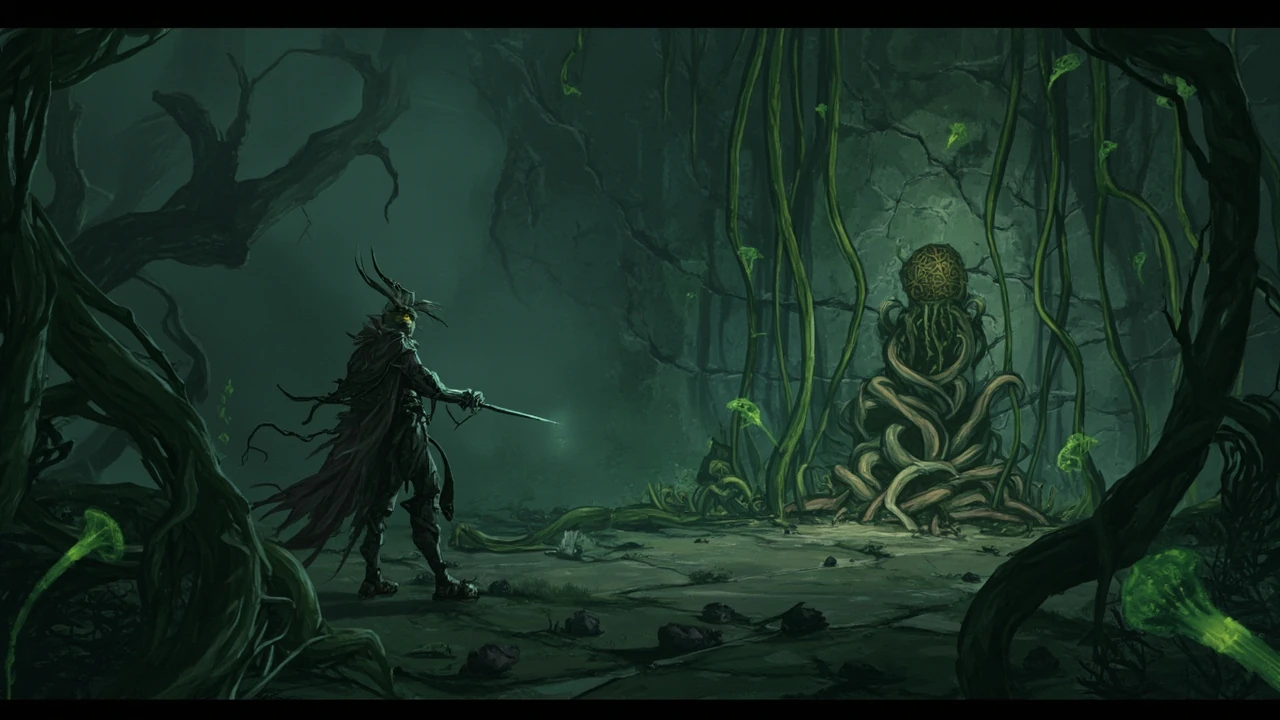
- Look for the visual signature: a cluster of pale, twisting vines anchored to a wall, with a single bulbous growth that pulses in a slow rhythm. It is larger than the ambient flora and stands out even in dim lighting, because the pulse is timed to a particular ambient track that plays only in that room.
- Listen for the audio cue: a low, droning hum that begins softly when Hornet enters the adjacent corridor. It is not musical, the way the shellwood or windchime ambient tracks are, and it carries a faint vibration that some players describe as a sub-bass throb.
- Watch for the NPC marker: if a tracker thread is active, a small quest indicator will appear in the corner of the screen, pointing toward the bud’s room rather than toward a generic wayward NPC. The icon style is shared with other named curiosities, so it does not name the bud outright until the player is close.
Players often miss the entrance because the main path continues upward and the side tunnel looks decorative. It is not. Every side tunnel in Pharloom’s lower regions exists either to host a quest, a vendor, a bench, or a shortcut, and a quick five-second scan before moving on is a habit worth keeping. The bud’s tunnel is no exception, and the entrance is wide enough for Hornet to walk through without crouching, which is itself a hint that the developers intended the room to be visited.
Reading the encounter before you commit
The twisted bud functions as a hybrid environmental hazard and enemy. It does not chase the player in the same way a grounded foe does, but it reacts aggressively to damage and to sustained presence in its room. There are three behavioral phases worth learning before any button is pressed, and each phase has its own audio sting, which helps players identify transitions without staring at the health bar.
| Phase | Trigger | Bud behavior | Player response |
|---|---|---|---|
| Dormant | Player enters but does not attack | Slow pulse, no contact damage unless touched directly | Scout the room, identify ledges, plan the opening |
| Agitated | First strike or sustained presence after a short timer | Bud extends lashing tendrils in a fixed arc, roughly 180 degrees around its base | Stay above or to the side, strike from a downward angle |
| Enraged | Below roughly 30 percent of its visible health | Faster lash cycle, occasional spore burst that adds a short damage-over-time effect | Commit to aggression, save healing for the spore window |
The percentages above are based on community observation of preview footage and may shift in the final build, since Team Cherry has historically rebalanced encounter health in patches. The structural point is that the fight has clear states, and recognizing the transition between them is more useful than memorizing a single combo. Players who try to heal in the agitated phase usually take a free hit from the lash, and players who refuse to heal in the enraged phase usually lose to the spore burst. Patience early, aggression late is the working pattern, and players who internalize it tend to clear the fight on the second or third attempt rather than the eighth.
Step-by-step approach to the fight
With the phases in mind, the actual fight can be broken into a repeatable sequence. The exact timing windows differ between players, because Hornet’s pounce arc, silk-soar trajectory, and needle range all vary by crest and by upgrade level, but the shape of the engagement is consistent.
- Open from a downward pounce. A descending strike hits the bud’s upper body and avoids the lateral lash arc, which is the safest opener in the dormant phase and a reliable way to start the agitated phase on your terms.
- Back off after one or two hits. The agitated phase begins after the third or fourth landed strike, and staying close during that window is the most common way to lose a mask. Retreat to a ledge, let the lash arc settle, and re-engage from above.
- Use vertical space. Hornet’s wall-pounce and silk-soar let the player re-engage from above, which is the safest angle in the agitated phase because the bud’s lash arc sweeps horizontally and the downward strike comes from outside that sweep.
- Save silk for healing or a counter-strike. Healing in this fight is expensive in silk, and a single well-timed heal is usually enough to survive the enraged phase. Burning silk on offense in the agitated phase is a common mistake that leaves the player with no emergency resource when the spore burst lands.
- Commit to the final stretch. Below 30 percent, the bud’s lash speed increases, but its spore burst has a longer wind-up. Closing distance during the wind-up prevents both the lash and the burst from connecting, and a clean downward pounce into the bud’s exposed top is usually the killing blow.
Players who die in the first or second attempt usually do so because they treat the bud as a stationary target. It is not. It has limited mobility, but the lash and the spore burst are the real threat, and a player who keeps moving vertically will outpace both. Players who die on the fifth or sixth attempt usually do so because they have not changed their crest, their needle, or their silk usage, and the same mistake is repeating with a different mask count.
What happens after the bud is dealt with
This is where the line between confirmed and speculated gets sharper. In the original Hollow Knight, defeating or interacting with a named curiosity often triggered a short dialogue sequence and either a currency reward, an item, or a permadeath-adjacent effect that the player could choose to accept or refuse. The sequel follows the same general pattern, but the specific reward tied to the silksong twisted bud is one of the details that varies between demo builds and the shipping version, and pre-release datamines have disagreed on the exact outcome.
What can be said with reasonable confidence is that the quest has a real resolution state. The bud is not a respawning environmental piece, and the room changes once the encounter ends. Whether the change is a chest, an NPC, or a passage to a previously inaccessible area depends on the build, and the safest assumption is that the player should finish the quest to see the result rather than look it up mid-fight. The IGN differences and new features guide is a useful secondary reference for how Team Cherry has historically layered these resolution states, because it documents similar quest patterns from the original game alongside the sequel’s redesigns.
How this quest compares to similar sub-quests in Silksong
Silksong includes a number of named curiosities and small sub-quests that follow the same general shape: locate the object, deal with a localized threat, claim a reward, and check whether the surrounding room has changed. The twisted bud sits in the middle of that range in terms of difficulty and time investment, and it is a useful benchmark for new players who want to know whether their current build is ready for the longer quest chains.
| Quest type | Time to complete | Combat demand | Platforming demand | Likely reward tier |
|---|---|---|---|---|
| Twisted bud | 5-10 minutes once located | Moderate, single target with three phases | Low to moderate, vertical layers | Small to mid |
| Shellwood shrine thread | 10-15 minutes | Light, multiple small targets | Moderate, branch routes through the canopy | Small |
| Bonegrave reliquary | 15-25 minutes | Heavy, multi-phase boss with adds | Moderate to high, hazard floors and falling blocks | Large |
| Wandering NPC escort | 10-20 minutes | Variable, escort rules and rescue windows | Low, mostly traversal between waypoints | NPC-gated, often dialogue or vendor unlock |
Read across the row, the twisted bud is the right kind of quest to attempt once the player has a working build but has not yet committed to a long boss thread. It is a checkpoint for whether the player’s current kit can handle a focused combat encounter with limited healing room, and it rewards the player for paying attention to phase transitions rather than raw damage output. Players who clear the bud cleanly are usually ready for the next tier of sub-quest, and players who struggle with the bud often find that upgrading the needle, switching crests, or practicing the wall-pounce timing is enough to flip the encounter.
Common failure modes and how to avoid them
Several recurring mistakes show up across the community’s reported attempts. None of them are unique to this quest, but each one is amplified by the bud’s specific behavior, and a player who knows the failure modes in advance is more likely to adapt on the first attempt rather than the fifth.
- Healing at floor level. The bud’s lash arc covers the lower platform, and a heal there is almost always interrupted by the next sweep. Heal on a ledge, in a corner, or after a vertical retreat that takes Hornet out of the arc.
- Ignoring the spore burst. In the enraged phase, the spore is a short damage-over-time effect that stacks with the next lash. Players who survive the lash but ignore the spore usually lose a mask to the combined effect, and a single mask loss in the enraged phase is often the difference between clearing the fight and restarting from the bench.
- Leaving the room to heal. Unlike some Metroidvania rooms, the bud’s room is not a free reset zone. Leaving may reset the encounter or, in some builds, force the player to re-clear the side tunnel before re-entering. Test the behavior once on a low-stakes attempt before relying on it as a strategy.
- Equipping the wrong crest for the fight. Crests that favor horizontal mobility or short burst combos struggle against a vertically layered target. Switch to a crest with a strong downward strike, a useful silk-soar, or a silk-heavy loadout before the encounter, and avoid crests that lock the player into long ground animations.
- Forgetting to talk to NPCs after the fight. Hollow Knight’s quest system is conversational, and an NPC who mentioned the bud before the fight will usually have a new line after it. That line sometimes opens the next thread in a chain, and skipping it is the most common way players lose track of a sub-quest midway through a run.
Reward handling and what to do next
After the bud is resolved, the practical question is what to do with whatever the quest returns. Without confirming a specific item, the safe play is to treat the reward as a small but real upgrade, useful for the next two or three rooms rather than for the rest of the run. Spend the silk on healing when the next sub-quest is in sight, save the rosaries for a vendor that the player has not yet exhausted, and check whether the bud’s room has a new exit, a new chest, or a new NPC line.
One useful follow-up is to revisit any NPCs who referenced the bud in passing dialogue. Hollow Knight’s quest system is often conversational, and an NPC who mentioned the bud before the fight will usually have a new line after it. That line sometimes opens the next thread in a chain, and skipping it is the most common way players lose track of a sub-quest midway through a run. Players who keep a short mental note of which NPCs mentioned which curiosities tend to find the larger quest arcs faster, and they tend to spend less time backtracking through already-cleared biomes.
A second useful follow-up is to map the bud’s room against the wider route. If the post-encounter state opens a passage, the passage often leads to a bench, a vendor, or a shortcut back to a previous biome, and the player who notices that shortcut early is the player who spends the least time climbing back up after a death elsewhere. Treat every resolved sub-quest as a potential map edit, and check the surrounding two or three rooms before moving on to the next objective.
How this quest fits the broader design of Silksong
Silksong is built on the same design pillars as the original: short, focused combat encounters separated by traversal and exploration, a minimal but consistent journal, and a strong sense that the world remembers what the player has done. The twisted bud is a clean illustration of those pillars. It is a contained encounter, it rewards observation, and it changes the room it lives in. It is also the kind of quest a returning Hollow Knight player can complete in a single sitting without committing to a multi-hour run, which is a meaningful piece of pacing for a Metroidvania of this size.
From a design perspective, the bud also shows how Team Cherry handles the transition from the original game’s aesthetic to the sequel’s. The original leaned into fungal and parasitic imagery, with green-gray palettes and crowded organic textures. The sequel pushes further into silk, thread, and woven environments, with brighter highlights and more architectural framing, and the bud is one of the visual bridges between the two. Players who notice that bridge often find the surrounding biome’s flavor text more rewarding, because the art is doing a small amount of narrative work that the dialogue does not.
For developers reading this as a case study, the bud is also a useful example of how to design a sub-quest that respects the player’s time. The encounter is short enough to attempt in a single session, the room is small enough to learn quickly, the phases are clear enough to teach themselves through observation, and the reward is meaningful enough to justify the detour without breaking the run’s economy. None of those qualities are accidental, and the original Hollow Knight used the same recipe for several of its most-loved curiosities, which is part of why the community has latched onto the bud as a benchmark for the sequel’s quest design.
Practical build suggestions for the silksong twisted bud
While the exact crest and charm economy in the shipping version may differ from the demo, a few practical build choices have held up across preview footage. These are suggestions rather than prescriptions, and the player should adapt them to the crests they have already unlocked.
| Slot | Suggested option | Reason it helps | Risk if swapped out |
|---|---|---|---|
| Needle | Mid-tier, at least three upgrades above base | Cuts the fight length and gives more room for error | Fight drags into a fourth lash cycle, increasing mask loss |
| Crest | Crest with strong downward strike or silk-soar | Keeps the player above the lash arc | Player is pinned to the lower platform and takes free hits |
| Charms | One healing-efficient charm, one mobility charm | Extends the heal window and the escape routes | Player runs out of silk mid-fight or cannot reach the upper ledge |
| Silk reserve | Full or near-full at the encounter | Covers one emergency heal and one counter-strike | Player is forced to choose between healing and aggression in the enraged phase |
Players who do not yet have a mid-tier needle or a suitable crest should not treat the bud as a hard gate. The quest is skippable, and the reward is a small to mid-tier item rather than a critical upgrade, so the cost of returning later is usually lower than the cost of forcing the encounter with an under-leveled build. The original Hollow Knight rewarded patient players with cleaner encounters, and the sequel appears to follow the same logic.
Community discussion and how to read it
The twisted bud has been a recurring topic on Silksong wikis, Discord servers, and Reddit threads since the first demo build surfaced, and the community has produced a range of opinions about its difficulty, its reward, and its place in the broader quest structure. A few habits help when reading that discussion.
First, separate preview footage from shipping footage. Build differences are real, and a tip that worked in a 2022 demo may not work in the final release. Second, separate datamined text from in-game text. Datamines reveal what the developers shipped as strings, but not every string is reachable in the final build, and some rewards are gated behind quest states that the dataminer may not have triggered. Third, separate strategy advice from lore interpretation. A thread about the bud’s reward tier is more reliable than a thread about the bud’s narrative symbolism, because the reward is testable and the symbolism is interpretive.
Finally, treat any walkthrough that promises a specific reward with caution until the final patch notes are public. The IGN differences and new features guide is a useful secondary source because it documents the sequel’s mechanical changes against the original, and it is maintained by an editorial team rather than by individual contributors, which makes it a more stable reference than a single Reddit post. For background on the original game’s design lineage and the Metroidvania structure that Silksong builds on, the Hollow Knight Wikipedia article is the most reliable single starting point.
Frequently asked questions
Where exactly is the silksong twisted bud located?
The twisted bud is found in a side passage off a main thoroughfare in the lower-to-mid region of Pharloom, typically near a fungal or marrow-adjacent biome. The room is identifiable by a cluster of twisting vines, a low ambient hum, and a quest indicator in the corner of the screen if the thread is active. The exact room name may differ between demo and shipping builds, so navigation by audio and visual cues is more reliable than navigation by map label.
Is the twisted bud a boss or a sub-quest enemy?
It functions as a sub-quest enemy. It is more durable and more patterned than a regular foe, but it does not gate progression the way a named boss does. Treating it as a focused encounter with three behavioral phases is the most accurate way to approach it, and it is a useful benchmark for whether the player’s current build is ready for the longer quest chains.
What reward does the silksong twisted bud give?
The specific reward varies between demo and shipping builds, and the safest assumption is that the quest yields a small to mid-tier item, currency, or follow-up dialogue. Treat any online reward list as community observation until the final patch notes are public, and avoid spending silk or rosaries in anticipation of a specific payout.
Can the twisted bud be skipped?
Yes. The quest is not on a critical path, and the player can leave the room at any time before engaging. Skipping it does not lock out any other quest, but it does skip the room’s post-encounter state, which may contain a chest, a passage, or a new NPC line that the player will have to find on a later visit.
What is the best crest or loadout for this fight?
Crests and loadouts that favor vertical mobility, downward strikes, and a healthy silk pool tend to perform well. Avoid crests that rely on long horizontal combos, because the bud’s lash arc punishes extended ground time, and avoid crests that lock the player into long animations that cannot be canceled into a pounce.
Does the twisted bud respawn after resting at a bench?
Based on community observation, the bud does not respawn once it has been resolved. The room’s post-encounter state is stable, and the quest remains marked as complete in the player’s tracker. If the room does change after a patch, the article will be updated to reflect the new behavior.
How does this quest compare to similar Silksong encounters?
The twisted bud sits in the middle of the sub-quest range in terms of time, combat demand, and reward tier. It is shorter and more contained than a boss thread like the bonegrave reliquary and more combat-focused than a wandering NPC escort, which makes it a useful midpoint for players who are calibrating their build before tackling the longer chains.
Is the twisted bud referenced in dialogue before the fight?
In the original Hollow Knight, named curiosities were often hinted at in passing NPC dialogue, and Silksong follows the same pattern. Players who talk to NPCs near the bud’s biome often pick up a short line that points them toward the side tunnel, and that same NPC usually has a new line after the fight is resolved, which can open the next thread in a chain.
Can the quest be completed in under five minutes?
For a player who already knows the route and the phase transitions, the combat itself can be cleared in two to three minutes. First-time players should expect ten to fifteen minutes including the navigation and the learning curve, and players who die repeatedly should expect longer runs as they experiment with crests and silk usage.
Does the twisted bud quest affect the ending of Silksong?
There is no confirmed evidence that this quest alters the ending sequence. Most sub-quests of this scale contribute flavor, lore, and small mechanical rewards rather than branching the final outcome. If a future patch or datamine suggests otherwise, the article will be updated with the new information.





Leave a Reply