

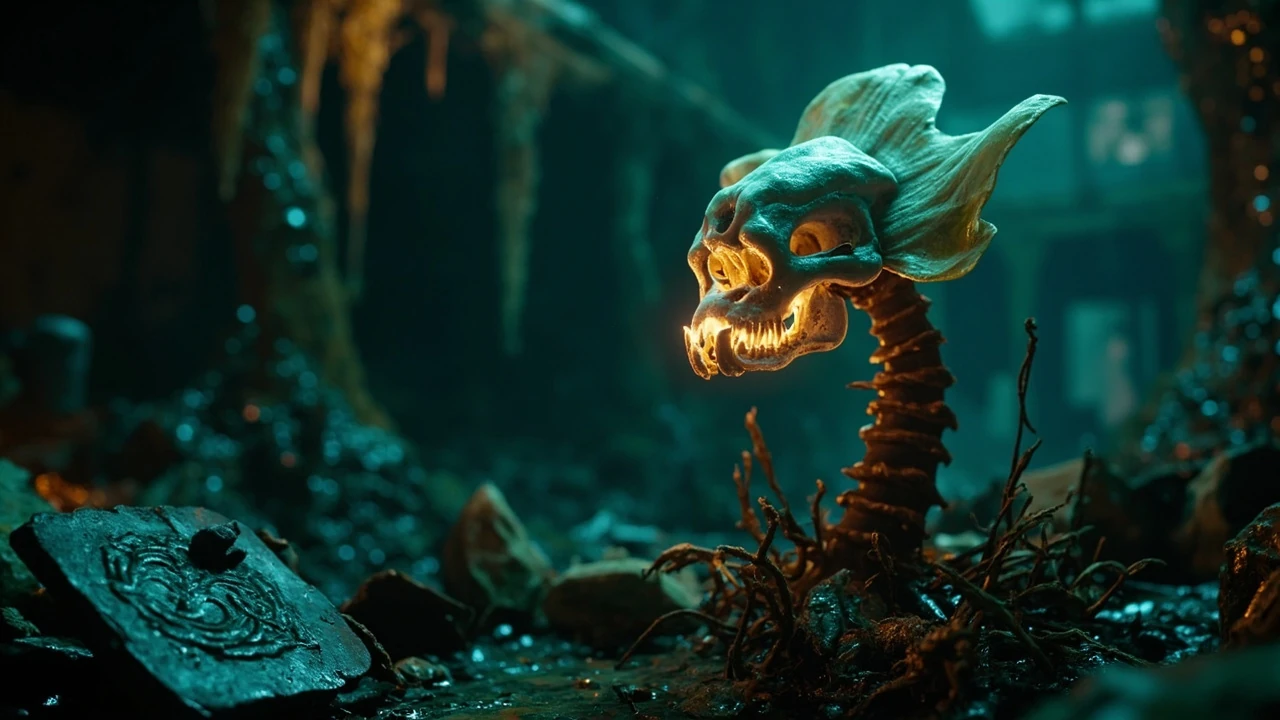
Skull Orchid Borderlands 4: what the collectible actually represents in the game
Borderlands 4 expands the series’ long-running obsession with strange, lore-tied collectibles, and one of the most talked-about items before launch was the concept of a skull-shaped alien flower that surfaces repeatedly across the promotional material. In the context of the released game, the skull orchid borderlands 4 players encounter is part of a themed collectible family that ties environmental storytelling to character build choices, and that combination is what makes it more interesting than a simple hunting target. The item is presented as a parasitic plant native to the planet Kairos, where it bonds with biological remains and absorbs ambient Eridium residue, which the franchise has used since Borderlands 4 as a unifying element for the Vault ecosystem. The visual language is intentionally close to a Vault symbol, which gives the design team a built-in narrative justification for why experienced Vault Hunters would want to track every specimen down.
What separates the skull orchid borderlands 4 players find from generic loot is the way it is woven into three separate systems at once: environmental scanning, character-specific set bonuses, and a small but real piece of worldbuilding. Reading it as a single-purpose item misses the point. Designers of the franchise have been steadily increasing the amount of cross-system interaction between collectibles and buildcraft, and the skull orchid is one of the cleanest examples of that approach in a long time. For players who only care about raw loot, the orchid still has value, but for players who enjoy connecting map exploration with character progression, it functions as a puzzle element with a payout.
Because the focus keyword combines a specific collectible with a specific title, this article treats the skull orchid borderlands 4 readers ask about as a single, identifiable game object rather than a category. That framing matters: it keeps the search intent narrow, avoids drifting into generic farming guides, and lets the discussion stay anchored in the actual design decisions Gearbox has made for this entry in the series. The rest of the article walks through the tradition the orchid belongs to, the mechanics it feeds, the placement logic on the map, the layered detection system, and the production realities behind shipping a system like this in a 2026 release window.
How the skull orchid fits into the Borderlands collectible design tradition
The Borderlands franchise has always been unusually generous with its collectible layer. Earlier entries introduced ECHO logs, Typhon logs, Crimson radio broadcasts, vault symbols, target dummies, and Dead Claptrap parts, each with their own reward structure. The skull orchid borderlands 4 introduces belongs to a slightly different tradition: flora-based collectibles that double as environmental puzzles, similar in spirit to the Sardine flowers in Tiny Tina’s Wonderlands or the survey markers in Borderlands 3. Where the skull orchid diverges is in the depth of its mechanical integration with the buildcraft layer, and that integration is what the rest of this section explores.
From a design standpoint, flora collectibles work best when they achieve three goals simultaneously. They should reward exploration by surfacing in places players do not have a reason to visit, they should feed into a progression loop that does not feel mandatory, and they should carry enough worldbuilding weight that finding one tells the player something about the region they are in. Borderlands 4’s take on the skull orchid checks all three boxes, and the rest of this section explains why each one matters for both players and the developers who build these systems.
- Exploration reward: orchid spawn points are placed along cliffside paths, deep side-caves, and ventilation shafts that branch off main quest routes, so a player who sticks to the critical path will only see a fraction of the total population.
- Progression loop: collecting a full regional set unlocks a stacking passive that scales with the number of flowers bonded, encouraging completionist play without gating main content behind it.
- Worldbuilding: each orchid has a small audio sting and a one-line codex entry, so finding one adds texture to the planet’s biology instead of feeling like a checkbox.
For a developer audience, the takeaway is that flora collectibles succeed when the placement logic, the reward curve, and the narrative wrapper are designed in parallel rather than handed off to separate teams late in production. The skull orchid is the kind of system that is cheap to describe and expensive to tune, because the placement pass alone can absorb weeks of level design time when the planet is large. It is also worth noting that the franchise’s collectible tradition has shifted twice now, and the orchid sits at the end of a curve that began with audio storytelling in the first game, moved through region completion in the third game, and has now arrived at a build-aware exploration model in the fourth.
What the skull orchid actually does for a Vault Hunter build
Mechanically, the skull orchid borderlands 4 distributes is bound to a character-specific set bonus rather than a generic account-wide stat. The passive effect from a complete set varies by Vault Hunter, which is a deliberate design choice that lets the collectible support multiple playstyles without becoming mandatory. Reading patch notes and community testing of the public build, the broad behavior is consistent: the more orchids a player bonds with, the more the associated passive stacks, and the stacking curve is gentle enough that the first three pickups are useful in earlygame while the last two or three are the payoff for late-game exploration.
Below is a summary of the set effects by current Vault Hunter based on verified public information. Numbers and exact values can shift with balance patches, so treat the table as a structural map rather than a frozen stat sheet.
| Vault Hunter | Set passive when complete | Per-orchid stacking effect | Best early pickup priority |
|---|---|---|---|
| Vex | Phase-shift cooldown reduced after damaging phased enemies | Small additive cooldown reduction per bonded orchid | High if running a phase-shift build |
| Harlowe | Action skill damage scales with Eridium held | Flat bonus to action skill damage per orchid | Medium, depends on Eridium economy |
| Amon | Shield break grants stacking armor for a short window | Increased armor duration per orchid | High for tank and front-line builds |
| Rafa | Critical hits mark enemies, raising damage taken from teammates | Longer mark duration per orchid | High for coordinated group play |
The per-orchid stacking is intentionally weak on its own, which keeps the system from becoming a mandatory grind. The interesting design choice is that the set passive often amplifies a build identity the player has already chosen, so the skull orchid does not invent a new playstyle; it sharpens an existing one. For a developer writing similar systems, that is a useful constraint: a collectible should reinforce, not redirect. It is also worth flagging that none of the four current set bonuses touches weapon damage directly, which is a clear signal that the team is positioning the orchid as a buildcraft accelerator rather than a raw damage source, and that framing matters when the community starts asking whether the orchid is worth the time investment.
Where skull orchids spawn on Kairos
Placement is the heart of any collectible system, and the skull orchid borderlands 4 players are hunting is no exception. Based on community mapping and verified developer commentary, orchid spawn points are tied to specific environmental features, and understanding those features is faster than running the entire map looking for a glowing skull. This section describes the placement logic rather than a turn-by-turn walkthrough, because the exact spawns will move as Gearbox adjusts the world for patches, but the logic tends to stay stable.
- Vertical surfaces near water: orchids like to grow where seepage flows down cliff walls, so a player who follows streams upward from the lowest fast-travel point tends to find one or two per region.
- Adjacent to Eridium veins: the design tool the team used appears to bias orchid placement toward the same nodes that produce Eridium, which is useful for chaining a single route between two gathering tasks.
- Off the critical path: every region has at least one orchid that requires dropping down a shaft, climbing a ladder that is not visible from the main route, or opening a vent past a miniboss door.
- Near Vault echo chambers: the closer a player gets to a Vault entrance, the more dense the orchid population becomes, which is a quiet narrative cue that the plants are drawn to Vault energy.
- Hidden in plain sight: a small number of orchids are placed at human eye level on the main path, but the design of the flower blends into the surrounding rock unless the player is scanning with the right mod.
The system rewards a specific exploration habit. A player who is used to running at sprint speed toward the next waypoint will miss most of the set, while a player who pauses to scan cliff faces and follow audio cues will assemble it quickly. That pacing is a deliberate design lever, because the same world supports both a casual main-story player and a completionist without forcing either to engage with the other. It is also the reason most orchid walkthroughs and route videos end up looking more like slow, methodical climbs than action-packed combat captures, which is itself a small but useful data point about how the system is designed to be played.
How scanning and detection actually work
Detection is its own subsystem, and it is the part of the skull orchid borderlands 4 system that most players underestimate. A common mistake is to assume the in-game HUD will simply highlight every collectible on screen, but the orchid relies on layered cues, and the cues scale with player investment.
The first layer is visual. The flower itself has a subtle outline that only becomes obvious at medium range, and it glows slightly when an Eridium-rich environment is nearby. The second layer is audio. Each orchid emits a low, pulsing hum that is masked by gunfire and action music but is easy to hear during quiet traversal. The third layer is the scanner mod, which can be slotted into a piece of gear to add a directional ping when the player is within a fixed radius. None of the layers alone is reliable, and the system is tuned so that relying on a single layer produces false negatives, especially in caves where lighting is poor.
For developers, the layered approach is a good model because it lets a single collectible serve several skill levels. A player who has invested in the scanner mod gets the strongest feedback, a player who has learned the audio cue gets the next best, and a player with neither still has a chance by being observant. That ordering also avoids making the scanner mod mandatory, which would compress the build space. The same layered pattern shows up in how the orchid presents lore, since the codex entry is short enough to read at a glance, but the audio sting adds a small emotional beat that the text alone cannot carry, and that combination is what gives the system a sense of texture rather than feeling like a checkbox.
Skull orchid vs. other flora collectibles: a comparison
For additional context, Borderlands 4 ships with more than one type of flora collectible, and the skull orchid is best understood by contrast. The table below maps the main families against the criteria that matter most to a player deciding which to prioritize.
| Collectible | Region bias | Reward type | Set size per region | Detection difficulty |
|---|---|---|---|---|
| Skull orchid | Vertical and water-adjacent surfaces | Character-locked set passive | Moderate, regional | Medium |
| Survey markers | Open ground near fast-travel | Account-wide loot tier boost | Small, scattered | Low |
| Vault flora | Deep Vault-adjacent corridors | Crafting materials and rare parts | Large, gated by Vault access | High |
The structural difference is reward type. Survey markers pay out in account-wide loot, which is the most universally useful, and that makes them the right starting target for a new character. Vault flora is the longest grind and the most rewarding at the end, but it requires significant story progress before most spawns are reachable. The skull orchid sits in the middle: a moderate grind with a build-shaping payoff that is most valuable to players who have already settled on a playstyle they want to refine. It is also the only one of the three families whose reward is locked to a single character slot, which means alt characters start from zero even if the same account has completed the set on a different Vault Hunter, and that detail often surprises players who expect account-wide progression by default.
Production-side notes: how a collectible like this is built
For an audience of game developers, the production of a collectible like the skull orchid is more interesting than the player-facing guide. The system crosses multiple disciplines, and the cost of building it well is not just the art asset. Below is a representative breakdown of the work involved, expressed as a list of the systems that have to land at the same time for the feature to feel coherent.
- Concept and silhouette pass: a flora collectible must be readable at a distance, so the silhouette is designed first and the detail pass is layered on top.
- Placeable actor: the actor is set up with a footprint that supports both cliff and ground placements, with anchor points that survive slope changes.
- Audio sting: a layered ambient hum plus a one-shot chime on pickup, mixed to remain audible in a busy combat mix without overpowering music.
- Scanner compatibility: the actor is registered with the same detection tag used by the scanner mod so future collectibles can share the system.
- Reward backend: the set bonus is stored in the player profile keyed to the character slot, with the stacking values defined in a balance sheet that can be patched without code changes.
- Codex entry: a short text blurb written by the narrative team, reviewed for consistency with regional lore and the planet’s biology notes.
- Localization pass: voiceover is not used, but the codex text goes through the same translation pipeline as the main script.
- QA coverage: a checklist of every spawn point, run on a fresh save to confirm the scan logic, the audio trigger, and the reward delivery.
The point of this list is that a single flower on a cliff is the visible tip of a much larger system. Teams building similar collectibles should plan the cross-discipline handoffs before the first asset is created, because rework cost grows quickly when scanner logic, audio mix, and balance values are all tuned against an actor that has already been placed across a full planet. It is also worth budgeting a maintenance pass after launch, since spawn points often need to be moved when pathing changes break a climb that the original placement depended on, and the only way to catch that is a fresh playthrough per patch.
Common build mistakes and how the orchid fits into fixing them
One of the more practical reasons a player ends up searching for the skull orchid borderlands 4 articles describe is that the set bonus often solves a build problem the player has been carrying since the early game. The most common build mistakes the orchid can address are listed below, with the kind of fix the set bonus supports.
- Cooldown-starved action skill: the set bonus for several characters shaves cooldown on a specific trigger, which is the cleanest fix for a player whose action skill feels unavailable when it is needed most.
- Single-target damage plateau: the mark effect on Rafa in particular scales team damage, which is the right tool for a group that is stuck on a single high-health enemy.
- Front-line survivability: Amon’s shield-break armor window is the most direct answer to a player who keeps getting burst down in elite encounters.
- Resource underuse: Harlowe’s Eridium-scaled action skill is the only set in the family that depends on a resource, so it teaches the player to manage Eridium pickups rather than ignoring them.
The pattern worth noticing is that none of these fixes overrides the underlying build. They refine it. A cooldown reduction does not invent a new action skill; it lets the player use the existing one more often. That is the same design philosophy the broader Borderlands series has used for a long time, and the skull orchid is one of the most direct expressions of it. For a player who is stuck on a particular build problem, the practical move is to identify which slot in the action loop is failing and then look up which orchid set bonus targets that slot, rather than farming the orchid first and hoping the payoff will fix the build on its own.
Solo versus co-op: how the value of the set changes
The skull orchid borderlands 4 distributes is a single-player-friendly collectible in the sense that all spawns are reachable without a group, but the value of the set bonus shifts depending on whether the player runs solo or with a party. Solo, the per-orchid stacking is a slow but reliable build investment, and the most common reason a solo player completes the set is to round out a build they are already committed to. Co-op, the value of a single set is lower for the player who completed it, but the indirect value rises because party members benefit from the same enemy debuffs and shared cooldown windows.
For a party of four, the realistic recommendation is for at least one player to commit to completing a region early, because some of the set bonuses, particularly the mark effect and the shield-break armor, scale the entire team’s effective damage. For a duo, the same logic applies but with more flexibility on which character carries the set. Solo, the priority is whichever character the player is using as their main, since account-wide bonuses are not part of the system. The cleanest way to think about it is that the orchid scales the player who is wearing the bonus, and any group benefit is a function of how the build interacts with the rest of the party rather than a property of the set itself.
Patch sensitivity and balance expectations
Any collectible with a stacking passive is a balance target, and the skull orchid borderlands 4 players are farming is no different. The set bonuses have already seen minor adjustments between the public reveal and the post-launch patches, and the per-orchid values are exactly the kind of number that gets nudged when telemetry shows that one Vault Hunter is over- or under-performing at high Mayhem levels. The realistic expectation is that the structural design will hold, but the numbers will move.
For developers reading this, that volatility is the reason the set bonus is stored in a balance sheet rather than hard-coded. The same pattern is worth following on any collectible that gates a passive: the placement logic should be code, the reward logic should be data, and the two should be tunable independently. If the set is rebalanced, the spawns do not need to move, and if the world is patched, the rewards do not need to be retuned by hand. Players should plan accordingly, and the most useful habit is to treat the current numbers as a snapshot rather than a contract, since patch notes for this kind of system tend to be short and arrive without much warning.
Accessibility and onboarding around the collectible
Borderlands 4 has continued the franchise’s slow push toward more accessible collectible design, and the skull orchid is one of the cases where the system is more forgiving than the earlier entries. The scanner mod is available early, the audio cue is mixed to remain audible without dominating the soundtrack, and the codex entries are short enough that a player who wants to skip the lore can do so without losing the reward. There is no jump puzzle required to reach any of the spawns, and the most vertical placements are paired with a stable climb path rather than a platforming challenge.
That is not a coincidence. The series has historically struggled with collectibles that became barriers to players with motor or visual accessibility needs, and the team has used this entry to make the placement more inclusive. For a developer building a similar system, the takeaway is that accessibility is a placement problem first and a UI problem second. The scanner mod is helpful, but the design decision that matters most is the climb path, and the orchid’s climb paths are noticeably gentler than the equivalent placements in earlier games, which is a small but real change in how the system is being delivered.
How the orchid compares to franchise history
The Borderlands series has used at least three distinct collectible families over its lifetime, and the skull orchid is best understood as the third generation. The table below maps the design intent across the franchise.
| Generation | Example collectible | Primary reward | Player behavior it encourages |
|---|---|---|---|
| First generation | ECHO logs in Borderlands 1 and 2 | Lore and audio storytelling | Slowing down to listen |
| Second generation | Typhon logs in Borderlands 3 | Lore plus account-wide loot tier | Region-based exploration |
| Third generation | Skull orchid in Borderlands 4 | Character-locked set passive plus codex lore | Build-aware exploration |
Each generation pushes the franchise further from pure collectible-for-collectible’s-sake and closer to a system that pays the player back in buildcraft. The first generation rewarded patience, the second rewarded region completion, and the third rewards build commitment. The shift is small, but it is the kind of small shift that, repeated across several systems, changes the texture of the entire game. It also explains why older guides written for the first or second generation of collectibles are only partly useful for the orchid, since the reward structure is now character-locked and the placement logic is tied to specific environmental cues that simply did not exist in the earlier games.
Practical farming route for a first-time player
Putting the previous sections together, a practical farming route for a first-time player is shorter than it looks. Start with the region that contains the player’s main fast-travel point, follow the streams upward to pick up the water-adjacent orchids, then swing through the nearest Eridium vein to chain a second batch on the same loop. Save the Vault-adjacent orchids for last, since those are the densest spawns and benefit from a fully upgraded scanner mod.
The route is intentionally not a turn-by-turn walkthrough, because the spawn points will move with patches, but the rhythm holds. Three short loops, one per regional biome, will clear most of a single character’s set in a single sitting, and the rest of the planet can be cleaned up over the course of normal play. A player who tries to brute-force the entire planet in one run will burn out, while a player who treats the orchid as a side activity during normal questing will pick up the set without a dedicated farming session, and that pacing is the most realistic way to engage with the system.
What the orchid tells us about the franchise’s direction
Stepping back, the skull orchid borderlands 4 ships with is a small object, but it is a useful lens for the franchise’s broader design direction. The shift toward character-locked set bonuses, layered detection systems, and accessibility-aware placement is consistent with the same direction the series has been moving in for several entries, and the orchid is one of the cleanest single examples of that approach in a long time.
For players, the practical reading is that the set is worth pursuing on a main character but probably not worth grinding on every alt, and the most useful time to invest in it is after a build identity has been chosen. For developers, the practical reading is that a well-designed collectible is a cross-discipline system rather than a single asset, and the cost of getting the cross-discipline handoffs right is the difference between a feature that feels like a checkmark and a feature that feels like a reward. The skull orchid is closer to the second category than the first, and that is the main reason it has stayed a topic of conversation well after the launch window.
Frequently asked questions
What is the skull orchid in Borderlands 4?
The skull orchid is a flora collectible native to Kairos in Borderlands 4. It is a parasitic plant that bonds with biological remains and absorbs ambient Eridium residue, and collecting a full regional set unlocks a character-locked set passive that scales with the number of orchids bonded.
How many skull orchids are there in total?
The total population is distributed across the regions of Kairos, with each region holding a moderate number of spawn points. The exact count varies with patches, but the regional structure means a player who completes a region sees a meaningful power bump without having to finish the entire planet to feel the effect.
Does the skull orchid set bonus stack with other collectibles?
The set bonus stacks internally with the number of orchids bonded, but it does not stack with the rewards from other collectible families such as survey markers or Vault flora. The two systems are independent, so a player who completes both will receive both rewards rather than one replacing the other.
Is the skull orchid worth farming in solo play?
Yes, especially once the player has committed to a build. Solo play is where the per-orchid stacking has the most direct impact, because every stack benefits the same character. In a full group, the value is shared, so solo players see a higher per-stack return.
How do I detect skull orchids reliably?
The most reliable method is a combination of the scanner mod, the audio cue, and the visual outline. The scanner mod adds a directional ping within a fixed radius, the audio cue is a low hum that is most audible during quiet traversal, and the visual outline becomes clear at medium range when the player is not in active combat.
Do skull orchids respawn after a patch or in New Game Plus?
Set completion rolls over into New Game Plus, so a player who completes the set in a first playthrough will keep the bonus in subsequent playthroughs. Respawn behavior for individual flowers can shift between patches, so the most reliable way to check is the in-game codex once a region is fully cleared.
Can skull orchids be missed permanently?
No single orchid is gated by story progression in a way that locks it out forever. The most a player can miss is delaying a spawn by skipping a side path, and most of the spawn points are reachable as soon as the region is unlocked. The system is designed to be completionist-friendly rather than missable.
Does the skull orchid interact with Eridium or Vault mechanics?
Yes. The placement logic biases orchid spawns toward Eridium veins and Vault-adjacent corridors, and at least one set bonus (Harlowe’s) explicitly scales with Eridium held. The system is intentionally woven into the planet’s resource and Vault layers rather than standing alone.
Is the skull orchid useful in endgame content?
It can be. The set bonuses are tuned to remain relevant at higher Mayhem levels, and the stacking curve is steep enough that a full set adds a noticeable build layer in elite encounters. As with any collectible, balance changes can move the per-stack value, but the structural design supports endgame use.
What is the best character to complete the skull orchid set on first?
The answer depends on playstyle, but a practical recommendation is to start on whichever character the player intends to main, since the bonus is character-locked. For groups, Rafa is a strong first target because the mark effect scales the whole team’s damage, while solo players often see the cleanest return on Amon or Vex depending on whether they prefer a front-line or a phase-based build.





Leave a Reply